"Currently, a number of spinoffs are truly orphaned securities trading at giveaway prices. For example, we have recently purchased shares of both of the recently separated subsidiaries of Tenneco, Inc. The larger company, Pactiv Corporation, manufactures Baggies brand food storage bags and Hefty brand trash bags, and has leading market shares in a myriad of other plastic packaging products. Due to indiscriminate post-spinoff selling pressure, the shares have slumped to around 10 times currently depressed after-tax earnings and about 5.5 times pretax cash flow. The earnings should grow from a combination of cost reductions, asset redeployments, bolt-on acquisitions, volume growth, and expected lower raw materials prices. Management recently received significant stock options as part of a new incentive plan to better align their interests with those of shareholders. They have also been buying stock personally. It has been many years since a branded consumer products business fell through the cracks to trade at such a compelling valuation.
We are also buying shares of the Tenneco Automotive spinoff; this company manufactures Monroe shock absorbers and Walker mufflers, and is the market share leader in nearly all of its products and markets. It currently trades at approximately four times after-tax earnings. It's shares have been particularly brutalized as a result of its deletion from the S&P 500 Index. Tenneco pre-spinoff traded at a market capitalization of several billion dollars; the highly leveraged Tenneco Automotive spinoff, still under extreme selling pressure, trades at a market capitalization barely above $200 million. Selling pressure has turned this market leader into a micro-capitalization stock, forcing many holders to exit because it no longer meets their size criteria. In effect, there is now a class of shareholders who must sell a stock simply because it trades at a depressed market valuation.
Harcourt General recently spun off most of its interest in Neiman Marcus, allowing it to become a pure play in the publishing and computer-based learning and training businesses. In the current turbulent market, we believe investors have failed to focus on the low valuation and highquality, strongly growing businesses within Harcourt. Currently, trading at a several year low, the shares trade for under 12 times cash earnings (earnings plus goodwill amortization) and for roughly half of our estimate of the company's asset value. The company is expected to grow earnings 12 - 15% annually, and recently reported strong quarterly results. Harcourt's management has most of their net worths invested in the company (which they control) and has committed to take additional actions as warranted to cause the company's share price to more fully reflect underlying business value.
Chemfirst, a specialty chemical company, came public several years ago as a spinoff. Despite the company's strong position in the fast growing electronics chemicals market, the shares trade at around five times estimated cash flow. Business results are strong, and the company's management owns a substantial interest in the company. In addition, the company is actively repurchasing its shares. We believe the company will eventually be acquired in the chemical industry's consolidation. We own several investments in the real estate area including shares in LNR Corporation, a spinoff a few years ago from a respected homebuilding company. This company is essentially an opportunistic investor in a variety of real estate assets, with a bias toward purchasing underperforming or out of favor properties, turning them around and selling them. They have achieved consistently strong returns over time, and the underlying value of the company's assets is close to twice the current market price of the shares. We expect underlying value to grow at a healthy rate for the foreseeable future. Management owns approximately 30% of the company's shares, and the company has been repurchasing substantial amounts of its own stock at the current price.
Octel was spun-off from Great Lakes Chemical Corporation in 1998 and has not succeeded in attracting investor interest. It is the world's dominant producer and marketer of worldwide TEL, a fuel additive that makes gasoline "leaded." This has been called a "sunset industry" because leaded gasoline is being phased out all over the world. In the meantime, however, it is a high margin business that requires almost no ongoing investment. Octel has recently consolidated its position and now controls in excess of 90% of the worldwide TEL market. The company is currently buying back around 10% of its stock per year. There are two primary risks - that the phase-out goes much more quickly than the 15-20% annual decline that management anticipates or that the company's abundant cash flow is squandered on foolish acquisitions rather than being used to pay down debt and buy back stock. At three times current after-tax earnings, valuation more than compensates for these risks.
We have recently become more active investors in thrift conversions. Thrifts at one time had a large dedicated community of investors, but after a period of overvaluation and poor stock performance, this is no longer true. While there are generally no short-term catalysts for value realization in this area, stock repurchases are accretive to shareholder value and industry consolidation seems likely to continue at a healthy pace. In short, the opportunity to buy significantly overcapitalized, conservatively managed thrifts between 50% and 75% of book value and at reasonable earnings multiples offer a low-risk investment with significant return potential.
We own shares in Stewart Enterprises, a funeral home and cemetery company which currently trades at approximately six times after-tax earnings per share. The death care industry has come under pressure as a result of overpriced acquisitions, excessive levels of debt, a recent, temporary decline in the death rate, and increased competition in some regional markets. All of the public companies in this industry are trading at extremely depressed levels. Stewart has some of the best properties in the industry; the company has recently repurchased its stock around current levels, and insiders have added to their holdings. A new management team is expected to reorient the company to maximize free cash flow generation.
Ucar is the world's leading manufacturer of graphite electrodes which are used in steel production. The company came under a cloud a few years ago when the industry admitted to price fixing. Results were then adversely affected by the Asian crisis last year. Management announced a sweeping cost cutting plan, which has been implemented faster than expected. Earnings are expected to grow strongly over the next few years as a result of lower expense levels, stronger demand, and possible price increases from currently depressed levels. The company also has announced a potentially lucrative product development and supply agreement with Ballard Power Systems, developers of a new fuel cell technology. Despite the company's excellent prospects and strong market position, the shares trade at roughly eight times estimated 2000 earnings.
Chargeurs is a French company which processes and trades in wool and produces fabrics, interlinings, and protective films. It is the market leader in virtually every segment in which it operates, generating substantial free cash flow from operations. Management is proactive in taking measures to maximize shareholder value including a securitization program to reduce volatility and risk in the trading business and the repurchase of a large number of shares. Some segments of the business have suffered as a result of the Asian crisis and are only now beginning to recover. Even on depressed results, however, the market values the company at approximately seven times earnings. Small capitalization companies in mundane businesses are out of favor in France, too.
Lambert Fenchurch is a publicly traded insurance broker in the U.K. Small in scale and in an industry that was out of favor amongst British investors, the company was unable to get a reasonable valuation from the stock market. Trading around 80 pence, the shares languished at six times earnings. Last month, after a long strategic review, the company accepted a takeover offer at 145 pence per share. The deal went unconditional on December 16.
Saab is a Swedish defense company primarily focused on aircraft, space and training systems which is valued at about seven times earnings. This valuation does not take into account growth opportunities available from the expansion of Saab's fighter aircraft program into the export market; the company recently received its first export order, validating our investment thesis. Management is also pursuing value creation through the monetization of the company's civilian aircraft lease portfolio. Last month, Saab agreed to purchase Celsius, another Swedish defense contractor, in a deal that enhances value by about 20% after cost-saving and revenue synergies. Although the European defense market is undergoing rapid consolidation, Saab, as one of the smallest remaining independent players, is below the radar screen of most investors.
We continue to have exposure to several investments whose outcome is totally independent of the level of the stock market. One such holding is Trustor Corporation, which is in liquidation. The company's assets are cash and legal claims against a former executive who committed embezzlement. Cash on hand exceeds the share price and a substantial liquidating distribution is expected shortly. Another such investment is in the debt of Maxwell Communications, which is also in liquidation. This company continues to make good progress selling off its assets and resolving legal claims at better-than-expected levels. Another liquidating distribution from Maxwell is expected in late December."
måndag 12 oktober 2015

tisdag 29 september 2015
Carl Icahn utfärdar varning i ny video
Scrolla ner på hemsidan så finner ni videon "Danger ahead". Saknar man specialintresse för amerikansk skattepolitik bör man hoppa över 02.00- 05.40 (rekommenderas för majoriteten).
Denna länken rekommenderas för de individer som tror att "bubblor" är osynliga.
söndag 20 september 2015
Vikten av att göra ingenting, Vito Maidas brev genom åren
(Det har väl gått snart 7-9 månader sedan jag gick igenom samtliga brev från Vito Maida och sammanställde lite utdrag. Kanske kan dessa utdrag vara av intresse. Inlägget skulle lagts upp för x antal månader sedan, men det blev ej så.)
Inkommande gigantiskt inlägg.
Inför millennieskiftet jobbade Vito Maida på ett större förvaltningsbolag och han vägrade att spekulera i teknikaktier under IT-manin i Kanada. Istället för att spekulera i IT-manin köpte han kanadensiska råvarubolag och lite guld. Vito Maida fick sluta på grund av sin positionering och startade upp Patient Capital Management (PCM). Kort efter uppstarten av PCM sprack IT-bubblan och guld sköt upp. Maida identifierar tidigt möjligheter och är en av de unikare placerarna jag funnit. Inför finanskrisen blankade PCM Wachovia, Bear Stearns och Lehman Brothers efter att han fått tillåtes att göra detta av en av sina klienter, men det är ett avsteg från hans normala metodik.
Nedan finns utdrag från Maidas brev till investerare från uppstarten av Patient Capital Management (PCM) fram till idag med fokus på perioden inför finanskrisen. PCMs resultat säger en del om vikten av att kunna göra absolut ingenting och inte sänka sitt avkastningskrav. Det är ganska otroligt hur man de senaste 15 åren kunnat kraftigt överprestera index genom att konstant ha en betydande kassa. PCMs kassa var som lägst under djupet av finanskrisen och uppgick då till drygt 30%.
Vito Maida är en exceptionellt skicklig kapitalplacerare och den goda avkastningen trots stora kassa positioner kan hänföras till detta. Är man disciplinerad och svingar bara när risk/reward är extremt bra behöver man inte vara fullt investerad någon gång för att slå index, såvida man kontinuerligt letar efter investeringar och bara håller en kassa när det inte finns bättre alternativ. Det är väldigt viktigt att poängtera att storleken på PCMs kassa beror på vilka investeringsmöjligheter som existerar.
PCMs (Patient Capital Managements) historiska avkastning finnes här.

Avkastningen är i många avseende imponerande, men avgifter är ej medräknade. Avkastningen blir väldigt imponerande när man justerar för risken förvaltarna på Patient Capital Management tagit. Alla Vito Maidas brev finnes här. Vito Maida köper helst lågt värderade större kvalitetsbolag och vill ha drygt 20 bolag i portföljen. Förvaltarna på PCM har förstås fel från och till, men ofta har de fått någorlunda rätt.
Jag börjar med ett utdrag från ett "brev" 2007-03 och därefter följer utdrag från utvalda brev från Vito Maida mellan 2000-2011 i kronologisk ordning. Grön färg indikerar en någorlunda positiv ton i Vito Maidas brev om aktier. Fokus har lagts på perioden fram till och strax efter finanskrisen. Fokus har även lagts på hans mentalitet kring bubblor, centralbanker, värdering och kassapositionering.
Det är förståeligt om TVn framstår som mer attraktiv än Vito Maidas brev och det är ett gott tecken på att man är psykiskt stabil. Om man inte gillar att kolla på TV kan man alltid skriva något narcissistiskt inlägg på Facebook om vad som skedde under dagen eller vad man åt till frukost.
"However, we believe that there is one enduring competitive advantage. The ability and desire of an investment organization or individual to stay true to a value based investment philosophy. A philosophy that requires behaviour that is contrary to human nature and holding unpopular beliefs and principles in the face of unrelenting pressures. These traits are a matter of temperament and character; they cannot be taught or bought. As Warren Buffett says, “you either have it or you don’t.”
This is the very reason why over a long period of time only true value investors have produced superior returns. Very few people can actually buy when others are selling and sell when others are buying. Only a very few are comfortable going against the crowd for a sustained period of time." (Vito Maida, 2007-03)
2000-09
Our objective is to provide a compound annual return of 5% per year above the S&P 500
and TSE 300 over a long period of time. We will always sacrifice short-term returns in
order to meet our long-term goal. This means that in some years our returns may not meet
our objective. So be it! I will not speculate or risk your capital and ours to meet some
annual benchmark. Long term investing is a marathon not a sprint! Our focus is also on
the preservation of capital. As Warren Buffet has stated: “The first rule of investing is not
to lose money. The second and third rules are not forgetting the first one.”
2002-03
Some prospective investors view our cash positions as a deterrent to committing their money to us. They question as some of you have, the validity of paying a management fee for managing cash. At PCM we employ a disciplined philosophy and process. The portfolio is a result of that philosophy and process. The work that we do is no different in a market where opportunities are few and far between than in a market where ample bargains exist. It just so happens that currently our process is leading to very few quality companies at reasonable prices. Even though our high cash position has made it harder to gather new assets from prospective clients, we are not willing to risk your capital and ours by investing in stocks that we believe are still significantly over-valued. Because of this disciplined philosophy, in the last two years we have managed to provide positive returns in negative markets, while giving clients the comfort of significantly less risk than the overall market.
2003-09
The bull is back!
It’s true. Just ask your local broker. Listen to the cheery business commentators on the
television and radio. Better still ask your boy genius fund manager; he too believes that it’s
true. Listen closely … all you will hear is bull.
Even though GDP growth for the third quarter was reported to be an astounding 7.2% we
at PCM aren’t buying into the bullishness. We believe that such a torrid pace is
unsustainable and has been fuelled by unprecedented monetary and fiscal stimulus, tax
rebates, and mortgage refinancing
(...)Market participants are once again abandoning any fear of risk in light of all this
bullishness. Ever the contrarians, we believe that it is at times such as these that it is
prudent to focus on risk.
2003-12

2005-03
Despite the challenging investment climate over the past five year period and our difficulty
in finding investments that meet our very strict criteria we have managed to outperform all
of the major North American equity indices. It is important to note that we have achieved
this performance with cash balances that have averaged approximately eighty per cent
over the past five years.
(...)While we are pleased with our performance we are disappointed that we haven’t been able to find more investment opportunities that meet our very high standards for quality, safety and value. When we have found these investment opportunities they have performed very well. Over the past five years our equity investments for our taxable and non-taxable portfolios have returned 25.53% and 39.70% respectively.
2005-12
These expensive valuations will inevitably lead to the “worst of times.” Excessive
valuations always lead to substantial losses. History tells us that this outcome is a certainty;
the only uncertainty is the timing of such losses.
These are also the “worst of times” for many value investors.
(...)Mr. Greenspan has been lauded as perhaps the greatest Federal Reserve Chairman ever.
Many would argue that under his leadership we have experienced the best of economic
times.
We view his tenure somewhat differently. In our opinion, Mr. Greenspan allowed several
investment bubbles to grow to dangerous levels and then aggressively liquefied the
financial system to avoid serious economic consequences once the bubbles burst. In turn,
this excessive monetary stimulus has lead to a broad based inflation in virtually every asset
class; the current housing bubble being the most dangerous. Perhaps, more importantly
Mr. Greenspan’s bailouts conditioned investors to believe that the consideration of risk is
of secondary importance when making investment decisions.
2006-12
As we enter 2007 we are again witnessing a period when investors are greedily buying. The
absence of fear and complacency towards risk truly astounds us. As is usually the case, the
cause for optimism and complacency is rooted in sharply rising short term security prices.
(...)Market participants believe that the Federal Reserve has engineered a “soft landing” for
2007; a perfect economy. Growth is expected to moderate to sustainable levels while
interest rates and inflation are forecast to fall. In addition, this perfect scenario envisages
corporate profitability that is expected to continue growing at a double digit rates and
remain at record levels as a percentage of GDP.
(...)In our view, this optimism is premature; significant risks are being overlooked. Both the
housing and automotive sectors are experiencing serious declines. Companies in both
industries are reporting steep declines in activity and profits. Historically a steep drop in
these important drivers of economic activity has foreshadowed a significant slowdown in
GDP growth.
(...)In times like this it is understandable that people get excited. The feeling of optimism is reinforced by the “crowd.” It is easy to believe that trees do grow to the sky and that the
sun always shines. But the history of financial markets shows us that it is precisely during
these times that caution should prevail. Mr. Market always seems to show us that risk does
exist; especially when it is least expected.
2007-03
Today this equity overvaluation is gaining momentum and is on the cusp of turning into a
bubble. Unlike the tech mania of 2000 or the Japanese stock market frenzy of 1989
virtually every asset class is overvalued today. As legendary value investor Jeremy
Grantham says: “Everything is in a bubble.” From real estate to junk bonds to art to
cyclical companies all assets are overvalued around the globe. In our view, there are very
few investments where investors are being rewarded for the risk assumed. To paraphrase
the academics “the risk premium is very low.” As stewards of your capital we say: “the
potential to permanently lose a substantial amount of capital is very real and very high! “
(...)Mortgage companies and sub-prime lenders are also reporting higher loan losses and delinquencies. The highly levered U.S. consumer is starting to show the strain of too much debt in the face of declining home values and a continuing negative savings rate. Should this condition spread to a wider number of Americans a slowdown will surely follow. Because the U.S. has been the engine of global growth the slowdown could turn into a global recession. Again, look out below!
(...) However, we believe that there is one enduring competitive advantage. The ability and
desire of an investment organization or individual to stay true to a value based investment
philosophy. A philosophy that requires behaviour that is contrary to human nature and
holding unpopular beliefs and principles in the face of unrelenting pressures. These traits
are a matter of temperament and character; they cannot be taught or bought. As Warren
Buffett says, “you either have it or you don’t.”
This is the very reason why over a long period of time only true value investors have
produced superior returns. Very few people can actually buy when others are selling and
sell when others are buying. Only a very few are comfortable going against the crowd for a
sustained period of time."
2008-03 (läs 2005-12 igen om Greenspan)
"The root of the current problems lay in the loose monetary policies put in place earlier in the century by then Federal Reserve Chairman Alan Greenspan. He dropped interest rates far to low and kept them there far to long in response to a mild economic slowdown following the bursting of the internet bubble and the terrorist attacks. The result of these low rates was to encourage excess borrowing in all areas of the economy. Most importantly consumers went on a borrowing binge; using the rising values of their homes as ATM machines.
(...)In contrast to our cautious view, many market participants believe that the worst of the
turmoil has passed. They argue that the aggressive interest rate cuts mentioned above,
government bailouts of troubled financial institutions and increased fiscal stimulus will
result in a resumption of growth in the latter half of this year. Equity investors appear to
share this view. The Dow Jones Industrial Average has increased by approximately eleven
per cent since its low point in mid March.
We strongly disagree with this view. In fact we strongly believe that there is more trouble
to come. Historically, there has never been a time when real estate values have declined
dramatically without serious economic fallout."
2008-12
At PCM we have traveled down a road not taken by many for a long time. Steadfast in our
unshakeable beliefs that risk and reward eventually balance out, that valuation is the key
determinant of long term returns and that the prudent and steady ultimately win the race we
stayed the course..
(...)There is no doubt that the current situation is disconcerting. Several financial institutions around the world are in a state of crisis, global economies are now in recession, unemployment is rising and newspaper headlines are quite scary. Conditions are likely to get worse before they get better. So we are buying! We have turned greedy when others have turned fearful. We are once again on the road less traveled. For the long term investor, shares of many high quality businesses are now priced to offer an acceptable return.
2009-12
While the above facts are sobering what is most important to us is the level of equity
valuations. In essence do valuations reflect the risk of the current environment and do
they provide an acceptable rate of return given those risks? In our estimation, current
aggregate equity prices have run far ahead of economic fundamentals.
(...)The very good news is that we are approximately sixty per cent invested; the highest that
we have ever been in our High Net Worth client portfolios. Most importantly, our
investments are still trading at a discount to their estimated intrinsic value and many
provide high dividends with the potential to increase over time.
2010-12
At the root of this enthusiasm in financial markets is the old adage; don’t fight the Fed. This approach essentially says that as long as the Federal Reserve is pursuing loose monetary policies money will flow into financial markets driving prices upward. This belief coupled with the view that government authorities will bail out financial markets in the event of trouble has once again resulted in excess valuations across several asset classes. Not only are most broad based equity indices overvalued but fixed income markets, commodity prices, emerging market equity and bond markets are all severely overvalued.
We believe that relying on Central Bankers to pump up and/or bail out financial markets is SPECULATION! Current policies implemented by the Federal Reserve create speculative rallies resulting in boom and bust cycles. There is ample historical evidence that these situations end badly. The substantial loses in Japanese equities in 1989, the technology bubble in 2000 and the financial meltdown in 2008 all had their roots in low interest rates and the strong belief that monetary authorities would prevent problems in financial markets.
2011-03
“It’s like déjà vu all over again.”
Yogi Berra
It has happened again!
Global central banks have created another bubble! The easy monetary policies and near
zero interest rates of the past two years have increased the appetite for risk. The lack of
interest income has pushed many investors to attempt to replace this income with capital
gains. In addition, low interest rates have encouraged speculators to borrow money and
invest the proceeds in the hope of making an interest rate spread or earning capital gains.
As we have seen in the past, these situations can only end badly.
2011-09 (greklandskrisen)
“Buy when there’s blood in the streets!’
Baron Rothschild
Equity markets have been extremely volatile lately and we love it!
(...)We welcome volatility! Our approach has worked quite effectively for many years and
through all sorts of tumultuous periods. Quality, value and most importantly time and
patience are the key ingredients to successful and low risk long term returns. These pillars
are the foundation of our philosophy and process and give us the confidence to buy when
others are fearful and sell when others are greedy. We could not implement our strategy
without your confidence and support. Thank you!
2014-06
 2014-09

Inkommande gigantiskt inlägg.
Inför millennieskiftet jobbade Vito Maida på ett större förvaltningsbolag och han vägrade att spekulera i teknikaktier under IT-manin i Kanada. Istället för att spekulera i IT-manin köpte han kanadensiska råvarubolag och lite guld. Vito Maida fick sluta på grund av sin positionering och startade upp Patient Capital Management (PCM). Kort efter uppstarten av PCM sprack IT-bubblan och guld sköt upp. Maida identifierar tidigt möjligheter och är en av de unikare placerarna jag funnit. Inför finanskrisen blankade PCM Wachovia, Bear Stearns och Lehman Brothers efter att han fått tillåtes att göra detta av en av sina klienter, men det är ett avsteg från hans normala metodik.
Nedan finns utdrag från Maidas brev till investerare från uppstarten av Patient Capital Management (PCM) fram till idag med fokus på perioden inför finanskrisen. PCMs resultat säger en del om vikten av att kunna göra absolut ingenting och inte sänka sitt avkastningskrav. Det är ganska otroligt hur man de senaste 15 åren kunnat kraftigt överprestera index genom att konstant ha en betydande kassa. PCMs kassa var som lägst under djupet av finanskrisen och uppgick då till drygt 30%.
Vito Maida är en exceptionellt skicklig kapitalplacerare och den goda avkastningen trots stora kassa positioner kan hänföras till detta. Är man disciplinerad och svingar bara när risk/reward är extremt bra behöver man inte vara fullt investerad någon gång för att slå index, såvida man kontinuerligt letar efter investeringar och bara håller en kassa när det inte finns bättre alternativ. Det är väldigt viktigt att poängtera att storleken på PCMs kassa beror på vilka investeringsmöjligheter som existerar.
PCMs (Patient Capital Managements) historiska avkastning finnes här.

Avkastningen är i många avseende imponerande, men avgifter är ej medräknade. Avkastningen blir väldigt imponerande när man justerar för risken förvaltarna på Patient Capital Management tagit. Alla Vito Maidas brev finnes här. Vito Maida köper helst lågt värderade större kvalitetsbolag och vill ha drygt 20 bolag i portföljen. Förvaltarna på PCM har förstås fel från och till, men ofta har de fått någorlunda rätt.
Jag börjar med ett utdrag från ett "brev" 2007-03 och därefter följer utdrag från utvalda brev från Vito Maida mellan 2000-2011 i kronologisk ordning. Grön färg indikerar en någorlunda positiv ton i Vito Maidas brev om aktier. Fokus har lagts på perioden fram till och strax efter finanskrisen. Fokus har även lagts på hans mentalitet kring bubblor, centralbanker, värdering och kassapositionering.
Det är förståeligt om TVn framstår som mer attraktiv än Vito Maidas brev och det är ett gott tecken på att man är psykiskt stabil. Om man inte gillar att kolla på TV kan man alltid skriva något narcissistiskt inlägg på Facebook om vad som skedde under dagen eller vad man åt till frukost.
"However, we believe that there is one enduring competitive advantage. The ability and desire of an investment organization or individual to stay true to a value based investment philosophy. A philosophy that requires behaviour that is contrary to human nature and holding unpopular beliefs and principles in the face of unrelenting pressures. These traits are a matter of temperament and character; they cannot be taught or bought. As Warren Buffett says, “you either have it or you don’t.”
This is the very reason why over a long period of time only true value investors have produced superior returns. Very few people can actually buy when others are selling and sell when others are buying. Only a very few are comfortable going against the crowd for a sustained period of time." (Vito Maida, 2007-03)
2000-09
Our objective is to provide a compound annual return of 5% per year above the S&P 500
and TSE 300 over a long period of time. We will always sacrifice short-term returns in
order to meet our long-term goal. This means that in some years our returns may not meet
our objective. So be it! I will not speculate or risk your capital and ours to meet some
annual benchmark. Long term investing is a marathon not a sprint! Our focus is also on
the preservation of capital. As Warren Buffet has stated: “The first rule of investing is not
to lose money. The second and third rules are not forgetting the first one.”
2002-03
Some prospective investors view our cash positions as a deterrent to committing their money to us. They question as some of you have, the validity of paying a management fee for managing cash. At PCM we employ a disciplined philosophy and process. The portfolio is a result of that philosophy and process. The work that we do is no different in a market where opportunities are few and far between than in a market where ample bargains exist. It just so happens that currently our process is leading to very few quality companies at reasonable prices. Even though our high cash position has made it harder to gather new assets from prospective clients, we are not willing to risk your capital and ours by investing in stocks that we believe are still significantly over-valued. Because of this disciplined philosophy, in the last two years we have managed to provide positive returns in negative markets, while giving clients the comfort of significantly less risk than the overall market.
2003-09
The bull is back!
It’s true. Just ask your local broker. Listen to the cheery business commentators on the
television and radio. Better still ask your boy genius fund manager; he too believes that it’s
true. Listen closely … all you will hear is bull.
Even though GDP growth for the third quarter was reported to be an astounding 7.2% we
at PCM aren’t buying into the bullishness. We believe that such a torrid pace is
unsustainable and has been fuelled by unprecedented monetary and fiscal stimulus, tax
rebates, and mortgage refinancing
(...)Market participants are once again abandoning any fear of risk in light of all this
bullishness. Ever the contrarians, we believe that it is at times such as these that it is
prudent to focus on risk.
2003-12

2005-03
Despite the challenging investment climate over the past five year period and our difficulty
in finding investments that meet our very strict criteria we have managed to outperform all
of the major North American equity indices. It is important to note that we have achieved
this performance with cash balances that have averaged approximately eighty per cent
over the past five years.
(...)While we are pleased with our performance we are disappointed that we haven’t been able to find more investment opportunities that meet our very high standards for quality, safety and value. When we have found these investment opportunities they have performed very well. Over the past five years our equity investments for our taxable and non-taxable portfolios have returned 25.53% and 39.70% respectively.
2005-12
These expensive valuations will inevitably lead to the “worst of times.” Excessive
valuations always lead to substantial losses. History tells us that this outcome is a certainty;
the only uncertainty is the timing of such losses.
These are also the “worst of times” for many value investors.
(...)Mr. Greenspan has been lauded as perhaps the greatest Federal Reserve Chairman ever.
Many would argue that under his leadership we have experienced the best of economic
times.
We view his tenure somewhat differently. In our opinion, Mr. Greenspan allowed several
investment bubbles to grow to dangerous levels and then aggressively liquefied the
financial system to avoid serious economic consequences once the bubbles burst. In turn,
this excessive monetary stimulus has lead to a broad based inflation in virtually every asset
class; the current housing bubble being the most dangerous. Perhaps, more importantly
Mr. Greenspan’s bailouts conditioned investors to believe that the consideration of risk is
of secondary importance when making investment decisions.
2006-12
As we enter 2007 we are again witnessing a period when investors are greedily buying. The
absence of fear and complacency towards risk truly astounds us. As is usually the case, the
cause for optimism and complacency is rooted in sharply rising short term security prices.
(...)Market participants believe that the Federal Reserve has engineered a “soft landing” for
2007; a perfect economy. Growth is expected to moderate to sustainable levels while
interest rates and inflation are forecast to fall. In addition, this perfect scenario envisages
corporate profitability that is expected to continue growing at a double digit rates and
remain at record levels as a percentage of GDP.
(...)In our view, this optimism is premature; significant risks are being overlooked. Both the
housing and automotive sectors are experiencing serious declines. Companies in both
industries are reporting steep declines in activity and profits. Historically a steep drop in
these important drivers of economic activity has foreshadowed a significant slowdown in
GDP growth.
(...)In times like this it is understandable that people get excited. The feeling of optimism is reinforced by the “crowd.” It is easy to believe that trees do grow to the sky and that the
sun always shines. But the history of financial markets shows us that it is precisely during
these times that caution should prevail. Mr. Market always seems to show us that risk does
exist; especially when it is least expected.
2007-03
Today this equity overvaluation is gaining momentum and is on the cusp of turning into a
bubble. Unlike the tech mania of 2000 or the Japanese stock market frenzy of 1989
virtually every asset class is overvalued today. As legendary value investor Jeremy
Grantham says: “Everything is in a bubble.” From real estate to junk bonds to art to
cyclical companies all assets are overvalued around the globe. In our view, there are very
few investments where investors are being rewarded for the risk assumed. To paraphrase
the academics “the risk premium is very low.” As stewards of your capital we say: “the
potential to permanently lose a substantial amount of capital is very real and very high! “
(...)Mortgage companies and sub-prime lenders are also reporting higher loan losses and delinquencies. The highly levered U.S. consumer is starting to show the strain of too much debt in the face of declining home values and a continuing negative savings rate. Should this condition spread to a wider number of Americans a slowdown will surely follow. Because the U.S. has been the engine of global growth the slowdown could turn into a global recession. Again, look out below!
(...) However, we believe that there is one enduring competitive advantage. The ability and
desire of an investment organization or individual to stay true to a value based investment
philosophy. A philosophy that requires behaviour that is contrary to human nature and
holding unpopular beliefs and principles in the face of unrelenting pressures. These traits
are a matter of temperament and character; they cannot be taught or bought. As Warren
Buffett says, “you either have it or you don’t.”
This is the very reason why over a long period of time only true value investors have
produced superior returns. Very few people can actually buy when others are selling and
sell when others are buying. Only a very few are comfortable going against the crowd for a
sustained period of time."
2008-03 (läs 2005-12 igen om Greenspan)
"The root of the current problems lay in the loose monetary policies put in place earlier in the century by then Federal Reserve Chairman Alan Greenspan. He dropped interest rates far to low and kept them there far to long in response to a mild economic slowdown following the bursting of the internet bubble and the terrorist attacks. The result of these low rates was to encourage excess borrowing in all areas of the economy. Most importantly consumers went on a borrowing binge; using the rising values of their homes as ATM machines.
(...)In contrast to our cautious view, many market participants believe that the worst of the
turmoil has passed. They argue that the aggressive interest rate cuts mentioned above,
government bailouts of troubled financial institutions and increased fiscal stimulus will
result in a resumption of growth in the latter half of this year. Equity investors appear to
share this view. The Dow Jones Industrial Average has increased by approximately eleven
per cent since its low point in mid March.
We strongly disagree with this view. In fact we strongly believe that there is more trouble
to come. Historically, there has never been a time when real estate values have declined
dramatically without serious economic fallout."
2008-12
At PCM we have traveled down a road not taken by many for a long time. Steadfast in our
unshakeable beliefs that risk and reward eventually balance out, that valuation is the key
determinant of long term returns and that the prudent and steady ultimately win the race we
stayed the course..
(...)There is no doubt that the current situation is disconcerting. Several financial institutions around the world are in a state of crisis, global economies are now in recession, unemployment is rising and newspaper headlines are quite scary. Conditions are likely to get worse before they get better. So we are buying! We have turned greedy when others have turned fearful. We are once again on the road less traveled. For the long term investor, shares of many high quality businesses are now priced to offer an acceptable return.
2009-12
While the above facts are sobering what is most important to us is the level of equity
valuations. In essence do valuations reflect the risk of the current environment and do
they provide an acceptable rate of return given those risks? In our estimation, current
aggregate equity prices have run far ahead of economic fundamentals.
(...)The very good news is that we are approximately sixty per cent invested; the highest that
we have ever been in our High Net Worth client portfolios. Most importantly, our
investments are still trading at a discount to their estimated intrinsic value and many
provide high dividends with the potential to increase over time.
At the root of this enthusiasm in financial markets is the old adage; don’t fight the Fed. This approach essentially says that as long as the Federal Reserve is pursuing loose monetary policies money will flow into financial markets driving prices upward. This belief coupled with the view that government authorities will bail out financial markets in the event of trouble has once again resulted in excess valuations across several asset classes. Not only are most broad based equity indices overvalued but fixed income markets, commodity prices, emerging market equity and bond markets are all severely overvalued.
We believe that relying on Central Bankers to pump up and/or bail out financial markets is SPECULATION! Current policies implemented by the Federal Reserve create speculative rallies resulting in boom and bust cycles. There is ample historical evidence that these situations end badly. The substantial loses in Japanese equities in 1989, the technology bubble in 2000 and the financial meltdown in 2008 all had their roots in low interest rates and the strong belief that monetary authorities would prevent problems in financial markets.
2011-03
“It’s like déjà vu all over again.”
Yogi Berra
It has happened again!
Global central banks have created another bubble! The easy monetary policies and near
zero interest rates of the past two years have increased the appetite for risk. The lack of
interest income has pushed many investors to attempt to replace this income with capital
gains. In addition, low interest rates have encouraged speculators to borrow money and
invest the proceeds in the hope of making an interest rate spread or earning capital gains.
As we have seen in the past, these situations can only end badly.
2011-09 (greklandskrisen)
“Buy when there’s blood in the streets!’
Baron Rothschild
Equity markets have been extremely volatile lately and we love it!
(...)We welcome volatility! Our approach has worked quite effectively for many years and
through all sorts of tumultuous periods. Quality, value and most importantly time and
patience are the key ingredients to successful and low risk long term returns. These pillars
are the foundation of our philosophy and process and give us the confidence to buy when
others are fearful and sell when others are greedy. We could not implement our strategy
without your confidence and support. Thank you!
2014-06


fredag 11 september 2015
Kina
"Kinas tillväxt de senaste åren har uppenbarligen byggt på ökad skuldsättning som i sin tur finansierat infrastruktur och fastighetsbyggnation. Förr eller senare kommer denna ohållbara utveckling upphöra och det är troligt att den slutar inom en 5 års period. Morgan Stanley uppskattar i en rapport att en tredjedel av Kinas kommuner tar upp nya lån för att kunna betala räntor på gamla lån. Nomura (japanskt finansbolag) uppskattar att ungefär hälften av Kinas kommuner har otillräckliga inkomster för att betala räntorna på sina lån.
2010 uppskattades det att 64 miljoner lägenheter stod tomma i Kina. Givet att en normal kinesisk familj består av 3 medlemmar skulle dessa lediga lägenheter kunna rymma 192 miljoner människor. Vad man ska notera i sammanhanget är att Kina drog igång de riktigt stora stimulansprogrammen efter finanskrisen. Så antalet tomma lägenheter lär knappast ha minskat utan snarare ökat betydligt.
När Kinas meningslösa byggande av fastigheter som ingen använder upphör, kommer priset på råvaror att kollapsa. Detta leder i sin tur till att länder med ett stort beroende av att exportera råvaror får stora problem (Australien, Kanada och Brasilien)." (mitt första inlägg 2014-04-13)
Som jag tidigare nämnt har Kina börjat vidta åtgärder för att hålla kommunerna flytande. De flesta råvaror har förstås kollapsat och Brasilien och Kanada är i recession. Sedan har vi förstås sett kollapsen på den kinesiska börsen och tragedin som följde (2.00 och framåt). Mycket av vad Prem Watsa varnat för de senaste åren har börjat ta form och man beundrar spektaklet.
I efterhand tycker jag det är väldigt intressant att jag i någon mening underskatta hur stor inverkan Kina skulle få. Givet den informationen jag hade borde jag dragit en betydligt mer allvarlig slutsats, men det spelar ingen större roll för jag höll mig borta från lämpliga sektorer. Att oroa sig för bubblor är i min mening något fullständigt naturligt, för annars riskerar man investera i bolag exponerade mot ohållbara trender och därefter betala ett pris för detta felaktiga agerande.
Jag är väldigt oroad över att nästan allt som ser billigt ut är extremcykliskt. Känns det inte konstigt att "alla" bolag som verkar inom stål, "semiconductor", kol, diamant, olje, koppar, aluminium eller gruvindustrin börjat få problem? Varför går "allt" extremcykliskt åt helvetet simultant? Det finns förstås ett enkelt svar på den frågan och det är att tillväxten är sämre än vad den ser ut att vara.
2010 läcktes de amerikanska diplomatförbindelserna av wikileaks:
The United States diplomatic cables leak, widely known as Cablegate, began on Sunday, 28 November 2010[1] when WikiLeaks—a non-profit organization that publishes submissions from anonymous whistleblowers—began releasing classified cables that had been sent to the U.S. State Department by 274 of its consulates, embassies, and diplomatic missions around the world. Dated between December 1966 and February 2010, the cables contain diplomatic analysis from world leaders, and the diplomats' assessment of host countries and their officials.[2] According to WikiLeaks, the 251,287 cables consist of 261,276,536 words, making Cablegate "the largest set of confidential documents ever to be released into the public domain. (Från wikipedia)
I ett av dokumenten diskuterade en amerikanska diplomat den kinesiska BNP-tillväxten med den nuvarande kinesiska premiärministern Li Keqiang. Under diskussion beskrev Li Keqiang (nedan) BNP siffrorna som "man-made" och "unreliable".
(min fetstil)
"4. (C) GDP figures are "man-made" and therefore unreliable,
Li said.  When evaluating Liaoning's economy, he focuses on
three figures:  1) electricity consumption, which was up 10
percent in Liaoning last year; 2) volume of rail cargo, which
is fairly accurate because fees are charged for each unit of
weight; and 3) amount of loans disbursed, which also tends to
be accurate given the interest fees charged.  By looking at
these three figures, Li said he can measure with relative
accuracy the speed of economic growth.  All other figures,
especially GDP statistics, are "for reference only," he said
smiling. " (Dokumentet finnes på wikileaks och det kan vara intressant att se hur amerikanska diplomater arbetar.)
"...the way we would look at it, it is probably very low single digit, if at all, and most of the stuff we look at is probably indicating maybe zero or slightly negativ... " (Jim Chanos om den kinesiska tillväxten, Intervju här, 24.40)
Man kan fråga sig om situationen verkligen är så allvarlig som Jim Chanos påstår, men det är troligt att den kinesiska tillväxten är svagare än den rapporterade.
Att ha en åsikt om makro handlar inte om att förutspå nästa bnp rapport eller att investera på basis av makro rörelser. Att ha en åsikt angående makro handlar om att undvika att vara den som investerar i ett subprime-bolag under början av subprime-krisen. Att ha en åsikt om makro handlar om att identifierar var det finns stora risker på sikt och där vinsterna ej är representativa för långsiktig intjäningsförmåga.
Jag ser med visst obehag hur mycket av det Prem Watsa varnat för börjar träda fram. Tråkigt nog underskatta jag hur stor effekten skulle bli initialt och dessutom har jag haft fel om i vilken följd händelserna skulle komma. Till bekanta har jag skämtsamt sagt att de som står utanför börsen kan vara lugna för Kina kommer förr eller senare säkerställa att det blir en rejäl krasch.
Jag frågar mig själv hur mycket mer rätt "jag" (Watsa) kommer få om Kina? Det är en sak att få rätt om en råvarukrasch och en helt annat att identifierar "katalysatorn" för en globala recession. Den som lever får se och förändras "datan" förändras den omedelbara bilden av Kina. Vad jag är mest rädd för är att en riktigt allvarlig och långvarig kris inträffar med räntorna i bottnen och dåligt stimulansutrymme, vilket jag diskutera i "Hur man löser en skuldkris!".
Många hävdar att Kina kommer bara fortsätta växa och väljer att ignorera de uppenbara varningstecknen. Som vanligt tar jag på mig rollen som pessimist och jag tror Kina kan ha en enorm global påverkan.
- Kinas ekonomi är stor.
- Kina har drivit tillväxten i de flesta råvaruexporterande länder och denna tillväxt kan komma att upphöra.
- Västvärldens tillväxt är svag med historiska mått och en försämrad kinesisk ekonomi kan dra tillväxten under nollan.
- Efter flera år med bubbeluppbyggnad är risken att någon externfaktor (Kina) prickar bubblorna och en självförstärkande effekt uppstår.
- Med många högt belånade aktörer, en högränte obligationsbubbla och extrema nivåer på buybacks är ekonomin/marknaden sårbar.
- Det har skapats en tro bland marknadsaktörer att centralbankerna kan rädda marknaderna oavsett vad som sker. Om marknaden plötsligt förlorar förtroendet kan värderingarna justeras ner kraftigt för att reflekterar en längre period med låg bnp-tillväxt och vinsttillväxt. Om placerare börjar fokusera på att rädda sitt kapital istället för att få en 1 % högre avkastning kan det urarta snabbt.
"After reading all of
this you may think that I am particularly pessimistic. It is not true: It is
all of you who are optimistic! Not only does our species have a strong
predisposition to be optimistic (or bullish) – it is probably a useful survival
characteristic – but we are particularly good at listening to agreeable data
and avoiding unpleasant data that does not jibe with our beliefs or
philosophies. Facts, whether backed by 97% of scientists as is the case with
man-made climate change, or 99.9% as is the case with evolution, do not count
for nearly as much as we used to believe. For that matter, we do a terrible job
of planning for the long term, particularly in postponing gratification, and we
are wickedly bad at dealing with the implications of compound math. All of this
makes it easy for us to forget about the previously painful market busts;
facilitates our pushing stocks and markets on occasion to levels that make no
mathematical sense; and allows us, regrettably, to ignore the logic of finite
resources and a deteriorating climate until the consequences are pushed up our
short-term noses." (Jeremy Grantham)
söndag 30 augusti 2015
"Avanza indikatorn" och den senaste nedgången i ett historiskt perspektiv
"Avanza Indikatorn"
Jag gick igenom hur antalet "Avanza kunder" förändrats så långt bak i tiden som datan är tillgänglig. "Depåkunder" likställs med "kunder" nedan. Jag väljer att fokusera på antal kunder framför antalet konton, eftersom Avanzas användare gått från att ha drygt 1 konto per kund till 1,8 konto per kund.Nedan ser man förändring (år över år) i antalet Avanza kunder. Siffran för 2015* representerar bara hur många nya kunder som Avanza fick under första halvåret 2015. Avanzas kundtillväxt var svag under IT-bubblans krasch, finanskrisen och eurokrisen. Mellan 2005-2013 tillkom drygt 15000-30000 nya kunder varje år. 2014 var kundtillväxten väldigt stark och under det första halvåret 2015 (2015*) var kundtillväxten lika stark som under helåret 2014.
¨

Om man kollar på förändringen i antalet kunder på halvårsbasis ser det ut enligt nedan och grafen nedan reflekterar bättre den extrema tillväxten under först halvåret 2015.

Det är svårt att säga något definitivt utifrån detta och det kan bara vara en slump att datan ser ut enligt ovan. Avanzas kundtillväxt sker ej linjärt, därmed kan enstaka år avvika kraftigt från tidigare år och detta kan leda till att man drar förhastade slutsatser av slumpmässiga variationer. Dessutom har Avanza bräddat sitt "sortiment" och därmed är kundtillflödet inte lika starkt relaterat till aktiemarknaden längre. Jag kan tänka mig att den låga räntan på bankkontot förmår individer att gå över till banker som Avanza för att få en högre ränta.
Kundtillväxt under 1,5 år (2014-första halvåret 2015)= 107000Kundtillväxt under 4 år (2010-2013)= 114327
Denna kundtillväxt är ju väldigt extrem så jag ville kolla hur det såg ut för Nordnet i samma period. Det visa sig vara svårt att hitta antalet "aktiva kunder" för Sverige under en längre period. Nordnet har också gjort en del förvärv under åren och det försvårar en jämförelse. Nordnets kundtillväxt i Sverige ("aktiva kunder") såg ut enligt nedan:
2014: 12200
2015 (första halvåret): 8900
Så Nordnets kundtillväxt första halvåret 2015 var stark i förhållande till helåret 2014, men mer kan man inte säga. Man kan bara konstatera att Nordnet blir krossad av Avanza i Sverige och det av uppenbara skäl, vem föredrar Nordnet framför Avanza?
Den senaste nedgången?
Man bör komma ihåg att inte ens de värsta börskrascher sker rakt neråt. Man bör också komma ihåg att det är omöjligt att skilja starten på en krasch från en tillfällig nedgång. En "börskrasch" tar 1-3 år och man bör komma ihåg att kraschen 2008 var förhållandevis hastig. Placerare bör börja köpa när undervärderade tillgångar uppstår, men det kan vara svårt när man inte reducerat sin exponering och när man har svårt att avgöra vad som faktiskt är undervärderat.
Det är troligt att centralbankerna börjar intervenera på marknaderna och man får helt enkelt se om marknaden kan återfå riskviljan igen. Redan nu har ECB och FED ledamöter börjat intervenera verbalt. FED ledamöter talar om att skjuta fram räntehöjningen i september och ECB ledamöter öppnar upp för nya stimulanser. Om dessa "verbala" interventioner kommer omsättas i handling eller endast är prat från enstaka individer är svårt att veta.
En del talar om att det är nu förmögenheter skapas och personligen kan jag inte se att några gigantiska möjligheter uppstått. Eller som Vito Maida beskrev nedgången i oktober:


(Patient Capital Management inc, 2014-09)
Som man kan se nedan har marknaden historiskt varit volatil och de senaste 15 åren är i mångt och mycket en anomali. Nedanstående data gäller den amerikanska börsen och den svenska börsen bör vara mer volatil. Mycket riktigt har den svenska börsen varit mer volatil än den amerikanska de senaste åren, men faktum kvarstår att den senaste nedgången inte är dramatisk, annat än i sin hastighet.

De senaste 6 åren har alla dippar varit köplägen och det kommer krävas en del för att placerare skall avskräckas. Även om jag tror att världsekonomin är dålig, så har inte prisfallet på den kinesiska fastighetsmarknaden återupptagits. Samtidigt kan något annat gå fel och björnmarknader behöver inte sammanfalla med recessioner eller vinstfall. Det är också viktigt att skilja på vilken ekonomisk statistik som är ledande och vilken som är eftersläpande.
Vad som är obehagligt är att många bolag har ungefär samma vinstnivå idag som de hade 2007. Sedan 2007 har vinsttillväxten varit svag och vi talar fortfarande om en "återhämtning" efter 6 år. Vad som är mest obehagligt är att börsen förmodligen inte skulle stå på 70% av dagens nivåer om ränteläget vore normaliserat. Uppgången bygger på luft och har drivits uppåt av kontinuerliga centralbanksinterventioner, detta kommer funka tills det inte gör det längre.
via Lance Roberts, (färgade områden anger start och slut på olika stimulanser (QE).

Det är ganska häpnadsväckande hur amerikanska ekonomer talar om att man bör skjuta fram den första räntehöjning på 0,25%. Hela den monetära politiken har anpassat sig efter marknaderna och det var också därför ECB intervenerade i oktober. När kommer marknadens stödhjulen tas bort? När kommer centralbankernas fokus skifta från marknaderna till att driva en ansvarsfull politik? Under de senaste 20 åren har centralbanksledamöters förnuft ersatts av en överdriven tilltro till modeller och en strävan efter att "optimera" ekonomin.
I sammanhanget bör man också komma ihåg att den ekonomisk statistiken sammanställs i efterhand och därför vet man sällan att man är i en recession. Björnmarknaden har alltså ofta inletts när "recessionen" dateras, vilket denna grafen från Lance Roberts illustrerar.
Belåningen på den amerikanska börsen minskade något i juli, men det är knappast ett gigantiskt ras. 2000 och 2007 skedde väldigt stora ras i belåningen inför marknadstoppen, men det inträffa knappast i juni. Riskaversionen på den amerikanska börsen var alltså relativt oförändrad. Kanske dök belåningen i augusti, men än så länge är det intet nytt på denna fronten.

Det kommer alltså inte komma några tydliga signaler om vart marknaden är på väg. Det är omöjligt att skilja starten på en krasch från en tillfällig nedgång och man kan bara hoppas på den riktningen man önskar.
torsdag 20 augusti 2015
Riskerna med återköpen av aktier och en varning till alla utdelningsinvesterare
Viacom är en gigantisk mediekoncern som äger diverse TV-kanaler och så vidare. Viacoms vinst efter skatt växte "bara" med 11% (blå) mellan 2011 till 2014, men vinsten per aktie växte med 51% (röd).
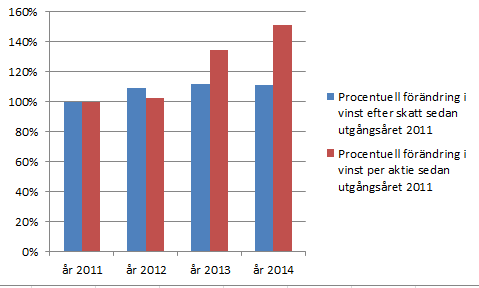
 Man kan diskutera om detta kursras är en överreaktion och ett potentiellt köpläge? Viacom ser relativt billigt ut, och är man sugen rekommenderas denna analysen på seeking alpha. Under vilka omständigheter som helst är det oroande att börsen drivs i så högre grad av återköp av aktier, då dessa återköp är cykliska.
John Hussman skrev nyligen om buybacks (återköp av aktier) och nedan finns några utdrag.
"The opposite of a debt-equity swap, of course, is a debt-financed stock repurchase, which leverages up the claims of existing shareholders. One of the more troubling aspects of the Federal Reserve’s suppression of interest rates is the speculation it has encouraged, by giving companies access to enormously cheap funding on a 5-7 year horizon. Though nominal economic growth has been tepid, revenue growth has turned negative, and profits as a share of GDP have been falling for more than a year, companies have scampered to boost their per-share earnings by taking out debt to repurchase and reduce the number of shares outstanding. This leveraging has been done at market valuations that are near the highest levels in history on historically reliable measures.

Mängden "buybacks" drivs alltså inte av att bolagsledningar vill köpa tillbaka undervärderade aktier, utan buybacks drivs av tillgången på spekulativt kapital. Det är också därför som "buybacks" sker vid "börstoppar" och upphör under björnmarknader. Under björnmarknader försvinner oftast riskviljan och därmed försvinner också det spekulativa kapitalet. Eftersom centralbankerna eldat på ett sökande efter avkastning leder detta till att spekulanter indirekt finansierar bolagsförvärv och återköp av aktier. I spekulanternas strävan efter avkastning söker sig det riskvilliga kapitalet till obligationsmarknaden, där kapitalet i sin tur lånas ut till företag som gör "buybacks". Dock glömmer spekulanterna bort risken för framtida betalningsinställelser och risken för förändringar i riskviljan.
Nedanstående graf från John Hussmans marknadskommentar (2014-09) illustrerar grafiskt det jag precis beskrivit.

Med rekordhöga återköp av aktier får man hoppas att denna gången är det annorlunda.
 (bild från denna artikeln)
Vad som brukar ske är att någonting leder till att spekulanterna får kalla fötter och försöker rädda sitt kapital. Sedan kommer bolagens marginaler under press och plötsligt blir de nyligen utgivna obligationerna svåra att betala tillbaka.
I min mening riskerar utdelningsinvesterare att drabbas hårt i nästa nedgång. Ofta kollar utdelningsinvesterare ensidigt på direktavkastning, utan att ta hänsyn till utdelningens andel av resultatet. Många av dessa placerare inser inte att direktavkastningen kanske är alla den avkastning de kommer få från bolaget. Spekulanterna missar också att bolagens vinster är föränderliga och att bolagen kan tvingas skära ner på utdelningen.
Här kommer en varning från Carl Icahn till alla utdelningsinvesterare och de som "sträcker" sig efter avkastning bland aktier, obligationer och preferensaktier.
Förslagsvis ser man mellan 0.00-2.00
https://www.youtube.com/watch?v=sBRphbVzS44

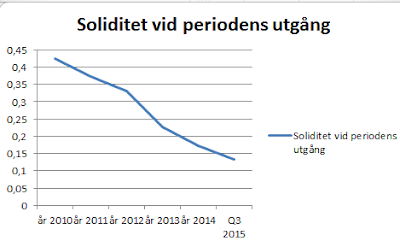
Hur åstadkom Viacom detta underverk? Jo genom att slakta balansräkningen,öka belåningen kraftigt och göra "buybacks". Soliditeten (utan hänsyn till obeskattade reserver) har gått från 42,5% till 13,3% i Q3 2015.
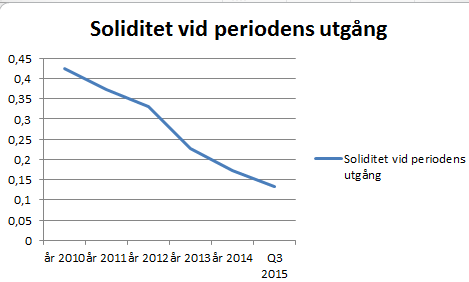
Viacoms stora återköp elda på ett stort rally i aktien, tills plötsligt vinsten började falla under 2015. Den sjunde april gick ledningen för Viacom ut och sa att de "tillfälligt" skulle sluta med återköpen. Detta är symptomatiskt för "buybacks" där ledningen ofta gör återköp vid höga värderingar och slutar vid lägre.

John Hussman skrev nyligen om buybacks (återköp av aktier) och nedan finns några utdrag.
"The opposite of a debt-equity swap, of course, is a debt-financed stock repurchase, which leverages up the claims of existing shareholders. One of the more troubling aspects of the Federal Reserve’s suppression of interest rates is the speculation it has encouraged, by giving companies access to enormously cheap funding on a 5-7 year horizon. Though nominal economic growth has been tepid, revenue growth has turned negative, and profits as a share of GDP have been falling for more than a year, companies have scampered to boost their per-share earnings by taking out debt to repurchase and reduce the number of shares outstanding. This leveraging has been done at market valuations that are near the highest levels in history on historically reliable measures.
See, the timing of buybacks at an aggregate level has nothing to do with value. As Albert Edwards at SocGen has often observed, not only do buybacks increase at rich market valuations and dry up in depressed markets, they are also typically financed by issuing debt. What drives buyback activity is not value, but the availability of cheap, speculative capital at points in the business cycle where profit margins are temporarily elevated and make the increased debt burden seem easy to handle.

(...)One emerging problem here is that credit spreads in corporate debt have begun to widen considerably, increasing the cost of debt, while profit margins continue (predictably) to come under pressure. Corporations tend to press their luck when it comes to buybacks, largely because profit margins tend to be deceptively high at major market peaks, but it’s difficult to maintain a high pace of repurchases when fading revenue growth and narrowing profit margins are joined by wider credit spreads.
The larger problem with repurchases is that debt-financed buybacks effectively put investors on margin. As corporations have borrowed in order to aggressively buy back their stock near the highest market valuations in history, existing stockholders have quietly become heavily leveraged, without even realizing it.
(...)So not only is the equity market at the second most overvalued point in U.S. history, it is also more leveraged against probable long-term corporate cash flows than at any previous point in history. As we observed during the housing bubble, yield-seeking by investors opens the door to every form of malinvestment. The best way to create a debt-financed wave of speculative and unproductive activity is to starve investors of safe return. In 2000 that wave of speculation focused on technology. The next Fed-induced wave of speculation focused on mortgage securities, which financed a housing bubble. In our view, the primary avenue of speculation in the current cycle has been debt-financed corporate equity purchases." (http://www.hussmanfunds.com/wmc/wmc150817.htm)
Mängden "buybacks" drivs alltså inte av att bolagsledningar vill köpa tillbaka undervärderade aktier, utan buybacks drivs av tillgången på spekulativt kapital. Det är också därför som "buybacks" sker vid "börstoppar" och upphör under björnmarknader. Under björnmarknader försvinner oftast riskviljan och därmed försvinner också det spekulativa kapitalet. Eftersom centralbankerna eldat på ett sökande efter avkastning leder detta till att spekulanter indirekt finansierar bolagsförvärv och återköp av aktier. I spekulanternas strävan efter avkastning söker sig det riskvilliga kapitalet till obligationsmarknaden, där kapitalet i sin tur lånas ut till företag som gör "buybacks". Dock glömmer spekulanterna bort risken för framtida betalningsinställelser och risken för förändringar i riskviljan.
Nedanstående graf från John Hussmans marknadskommentar (2014-09) illustrerar grafiskt det jag precis beskrivit.

Med rekordhöga återköp av aktier får man hoppas att denna gången är det annorlunda.

Vad som brukar ske är att någonting leder till att spekulanterna får kalla fötter och försöker rädda sitt kapital. Sedan kommer bolagens marginaler under press och plötsligt blir de nyligen utgivna obligationerna svåra att betala tillbaka.
I min mening riskerar utdelningsinvesterare att drabbas hårt i nästa nedgång. Ofta kollar utdelningsinvesterare ensidigt på direktavkastning, utan att ta hänsyn till utdelningens andel av resultatet. Många av dessa placerare inser inte att direktavkastningen kanske är alla den avkastning de kommer få från bolaget. Spekulanterna missar också att bolagens vinster är föränderliga och att bolagen kan tvingas skära ner på utdelningen.
Här kommer en varning från Carl Icahn till alla utdelningsinvesterare och de som "sträcker" sig efter avkastning bland aktier, obligationer och preferensaktier.
Förslagsvis ser man mellan 0.00-2.00
torsdag 13 augusti 2015
Uppdatering KLX inc
Jag har sålt KLX inc efter att jag upptäckt att jag klantat mig rejält. Tyvärr är jag varken så begåvad eller intelligent som jag skulle önska.
"Tes: Aerospace bör med lätthet värderas till p/e 15. Om Aerospace värderas till p/e 15 värderas Aerospace högre än KLX incs market cap. Förhoppningsvis vänder Energy Services tillbaka till lönsamhet och därmed ges en gratis option mot högre olje/gas priser. Skulle oljepriset förbli lågt är risken inte jätte betydande, givet den högkvalitativa verksamheten mot flygindustrin och den låga multipeln. Energy Services expanderar nu och sker en vändning i oljesektorn har bolaget goda förutsättningar för att dra nytta av vändningen." (inlägg den 28 juni 2015)
Jag missa en väldigt viktig "detalj" i KLX incs räkningar och detta leder till att hela investeringen faller ihop. Varför jag missa att ta KLX incs kapitalstruktur i beaktelse vet jag ej. Kanske var jag lite för optimistiskt lagd när jag kolla på KLX inc och blev förblindad av de trevliga siffrorna, samt att Baupost tagit en position. Denna miss leder till att KLX incs lönsamhet är betydligt mindre än jag räknat med. Man kan fortfarande rättfärdiga investeringen om man besitter gudomliga insikter och vet att oljepriset kommer återvända till 110 dollar per fat inom kort, men uppsidan har blivit mindre. Däremot har risken för en större kapitalförlust ökat vid händelsen av en längre period av "låga" oljepriser. Någon gratis option existerar alltså inte!
När man upptäcker att man gjort ett misstag blir det lätt så att man försöker rättfärdiga investeringen och detta är ett mycket farligt agerande. Är tesen död så är den död och därmed bör man avsluta positionen. Jag ursäktar den felaktigt optimistiska informationen i det tidigare inlägget.
Dollarkursen har gått åt rätt håll och förlusten blev -10% och innehavet uppgick till 3,5% av min "portfölj". Vad som händer fortsättningsvis är svårt att säga och jag skulle inte bli förvånad om att KLX inc kommer utvecklas väldigt bra på sikt. Jag har sålt något som Baupost (Klarman) köper och oddsen för att jag har rätt på sikt är låga. Dock "förstår" jag inte varför Baupost äger KLX inc och därmed är det dags att avsluta positionen.
“There is a complicating factor that makes the handling of investment mistakes more difficult. This is the ego in each of us. None of us likes to admit to himself that he has been wrong. If we have made a mistake in buying a stock but can sell the stock at a small profit, we have somehow lost any sense of having been foolish. On the other hand, if we sell at a small loss we are quite unhappy about the whole matter. This reaction, while completely natural and normal, is probably one of the most dangerous in which we can indulge ourselves in the entire investment process." (Philip Fisher)
"Tes: Aerospace bör med lätthet värderas till p/e 15. Om Aerospace värderas till p/e 15 värderas Aerospace högre än KLX incs market cap. Förhoppningsvis vänder Energy Services tillbaka till lönsamhet och därmed ges en gratis option mot högre olje/gas priser. Skulle oljepriset förbli lågt är risken inte jätte betydande, givet den högkvalitativa verksamheten mot flygindustrin och den låga multipeln. Energy Services expanderar nu och sker en vändning i oljesektorn har bolaget goda förutsättningar för att dra nytta av vändningen." (inlägg den 28 juni 2015)
Jag missa en väldigt viktig "detalj" i KLX incs räkningar och detta leder till att hela investeringen faller ihop. Varför jag missa att ta KLX incs kapitalstruktur i beaktelse vet jag ej. Kanske var jag lite för optimistiskt lagd när jag kolla på KLX inc och blev förblindad av de trevliga siffrorna, samt att Baupost tagit en position. Denna miss leder till att KLX incs lönsamhet är betydligt mindre än jag räknat med. Man kan fortfarande rättfärdiga investeringen om man besitter gudomliga insikter och vet att oljepriset kommer återvända till 110 dollar per fat inom kort, men uppsidan har blivit mindre. Däremot har risken för en större kapitalförlust ökat vid händelsen av en längre period av "låga" oljepriser. Någon gratis option existerar alltså inte!
När man upptäcker att man gjort ett misstag blir det lätt så att man försöker rättfärdiga investeringen och detta är ett mycket farligt agerande. Är tesen död så är den död och därmed bör man avsluta positionen. Jag ursäktar den felaktigt optimistiska informationen i det tidigare inlägget.
Dollarkursen har gått åt rätt håll och förlusten blev -10% och innehavet uppgick till 3,5% av min "portfölj". Vad som händer fortsättningsvis är svårt att säga och jag skulle inte bli förvånad om att KLX inc kommer utvecklas väldigt bra på sikt. Jag har sålt något som Baupost (Klarman) köper och oddsen för att jag har rätt på sikt är låga. Dock "förstår" jag inte varför Baupost äger KLX inc och därmed är det dags att avsluta positionen.
“There is a complicating factor that makes the handling of investment mistakes more difficult. This is the ego in each of us. None of us likes to admit to himself that he has been wrong. If we have made a mistake in buying a stock but can sell the stock at a small profit, we have somehow lost any sense of having been foolish. On the other hand, if we sell at a small loss we are quite unhappy about the whole matter. This reaction, while completely natural and normal, is probably one of the most dangerous in which we can indulge ourselves in the entire investment process." (Philip Fisher)
Prenumerera på:
Inlägg (Atom)