söndag 19 juni 2016

Den "humanitära stormakten" Sverige och invandringspolitiken

(Har aldrig röstat på SD och givet de framsteg som gjorts i migrationspolitiken ter det sig allt mer avlägset. Om man blir kränkt av att människor har andra åsikter än en själv så föreslår jag att man istället läser något på en lämpligare nivå. Nedan använder jag beteckningen invandrare i en väldigt vid bemärkelse. Arbetskraftsinvandring av högutbildad individer inom bristsektorer är förstås alltid önskvärt!)

Eftersom det inte finns särskilt mycket att skriva om angående börsen i stort så görs en liten utvikning i ett väldigt infekterat ämne i Sverige, invandringspolitiken. Migrationspolitiken präglas av känslor vilket leder till att felaktiga beslut tas. Normalt håller jag mig till börsen, men ibland skriver jag om saker som för tillfället intresserar mig.

Kostnaderna för invandringen

Många hävdar att Sverige gör en humanitär insats i och med flyktingmottagande, men problemet är att kostnaderna börjat skena, vilket syns i regeringens ändringsförslag under april 2016. Migrationen kostar nu mer än försvaret och börjar knappa in på kostnaderna för sjukvården. Märk hur kostnaderna för migrationen vida överstiger kostnaden för internationellt bistånd (UO 7)
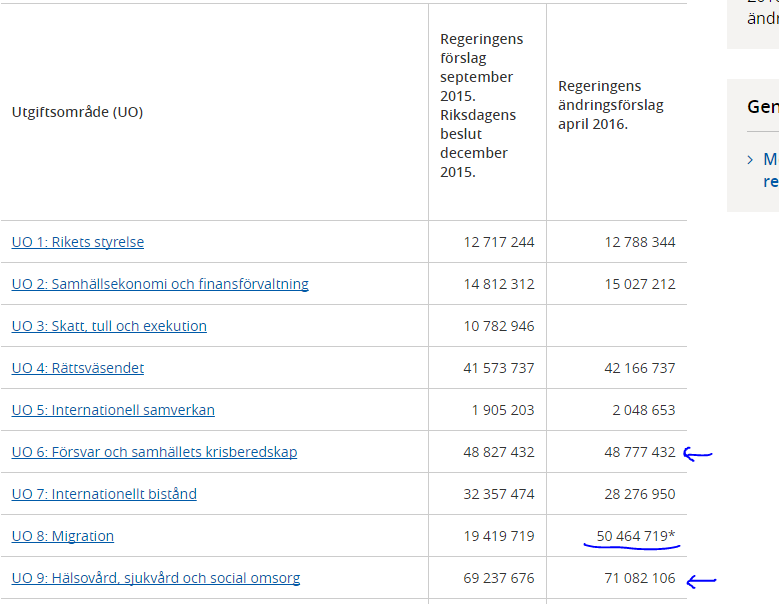

http://www.regeringen.se/artiklar/2015/09/statens-budget-2016-i-siffror/

Under posten UO13 framkommer fler kostnader som är direkt relaterad till migrationen:


Ovanstående 70 miljarder kronor består förstås bara av de kostnader som kan direkt relateras till migrationen. Minskar invandringen de kommande åren bör dessa poster minska. Ovanpå dessa kostnader tillkommer förstås alla indirekta kostnader såsom att invandrare generellt är överrepresenterade i brott och andra sammanhang. Man undrar också vad det kan kosta samhället att varenda hus på landet skall byggas om till "flyktingläger". Om man är en nyanländ flykting och placeras på en gård i obygden med 30 andra asylsökande, vilka förutsättningar har man att integreras i samhället?

Men Sverige kan ju tack vare sin generösa invandringspolitik vara en humanitär stormakt? Problemet med denna argumentation är att pengarna skulle göra betydligt större nytta om de faktiskt gick till närområdet. Även forskare som Hans Rosling hävdar att det är pengar i närområdet som behövs!

”Sveriges kostnader för asylmottagning samt långsiktig försörjning av flyktingar är minst 80 miljarder kr för ett några tiotusental flyktingar per år. FNs samlade finansieringsmål för 12 miljoner Syriska flyktingar är samtidigt ca 70 miljarder kronor (de brukar inte få in allt de äskar). Detta är en resursallokering som ingen rationell humanist kan försvara. Det är på samma sätt en skandal att Sverige har skurit 10 miljarder kronor ur biståndsbudgeten till förmån för bland annat flyktingsmugglare och Bert Karlsson." (Tino Sanandaji, blogg)

De som drabbas när våra politiker håller på med sin lekstuga är förstås inte de som slår sig för bröstet och talar om humanism. Det är de i närområdet som drabbas och inte får hjälpa, vilket Christopher Landin beskriver nedan:


Om man är en riktig humanist och vill hjälpa så många människor som möjligt bör man eftersträva att mer pengar skall gå till internationellt bistånd. Hävdar man något annat är man inte en humanist utan förespråkar endast en hög invandring för att vara populär i sociala sammanhang.

Migrationspolitiken är i vilket fall ej lönsam på sikt
Invandringen blir aldrig lönsam eftersom sysselsättningsgraden bland de med utländsk bakgrund aldrig når särskilt höga nivåer. Faktum är att invandringen aldrig blir lönsam, varken på kort eller lång sikt.

"När SCB räknar korrekt och anger andelen av arbetsför ålder som arbetar blir det tydligt att situationen är katastrofalt. Bara 57 procent av alla invandrare och 51 procent av utomeuropeiska invandrare i arbetsför ålder förvärvsarbetar. Motsvarande siffra är 82 procent för svenskfödda. I gruppen svenskfödda ingår ändå andra generationens invandrare. När dessa exkluderas och vi tittar på de med svensk ursprung så är andelen som förvärvsarbetar 85 procent, vilket redovisas i den här ett par år äldre regeringsrapporten, tabell 2.10.
SCB fortsätter: ”Trots en lång vistelsetid i Sverige är förvärvsfrekvenserna betydligt lägre bland utrikes födda än bland inrikes födda….Av de som bott i Sverige i mer än 20 år förvärvsarbetade 70 procent av männen och 68 procent av kvinnorna.”
Så drygt 30 procent av invandrare som bott i Sverige mer än 20 år jobbar inte jämfört med 15 procent bland de med svensk ursprung. Det är en vandringsmyt att invandrare efter sju år integreras på arbetsmarknaden. Kom ihåg att en typisk invandrare bara är på arbetsmarknaden i ungefär trettio år, inte en oändlighet. Varje år en vuxen person är utanför arbetsmarknaden är dyrbart för samhället. Invandrare som bara kommer i arbete efter tio eller tjugo år i landet hinner i regel inte betala in tillräckligt mycket i skatt för att täcka sin pension, sjukvård och andra förmåner innan de går i pension."(Tino Sanandaji, inlägg här)
Sverige bör föra en mer selektiv invandring som selekterar baserat på utbildning istället för att ha en selektionsprocess som bygger på vem som kan bäst slå sig igenom Europa. Personligen tror jag att det finns bättre selektionskriterier än vem som kan slå sig igenom Europa på kortast tid.

Könsobalans
I Sverige uppskattas det att det går 123 stycken pojkar på 100 flickor i åldersgruppen 16-17 år! Detta kan jämföras med det otroligt skeva landet Kina där det går 117 pojkar per 100 flickor. Vad kommer ske om dessa individer inte kan få jobb av förståeliga anledning (dålig utbildning+dålig svenska)? Vad händer om de inte ens kan hitta någon att sätta på? Jag skulle personligen vara jävligt förbannad, men det är bara jag. Jag sitter förstås inne med grava aggressionsproblem så jag kanske inte är helt representativ i sammanhanget.

(Denna könsobalans finns i hela den närliggande åldersgruppen 14-20 år..)

Framtiden?
Personligen bor jag som många andra "etniska svenskar" i en liten skyddad "idyll" utanför en större stad i Sverige och jag märker inte i någon större utsträckning av alla problem relaterat till invandringen. Att jag bor i en skyddad miljö förändrar inte faktumet att det numera finns väktare på många vårdcentraler i Malmö och att det sker skjutningar hela tiden. Att jag bor i en skyddad miljö förändrar inte att en läkarbekant brukar kolla om en polisbil står på akutmottagningen innan jouren påbörjas för kvällen. 

Sverige är ett av världens mest framgångsrika exportländer och ett fantastiskt land att leva i. Sverige kommer fortsatt vara ett fint land i framtiden och en hög invandring kommer inte medföra en systemkollaps. Dock hoppas jag att politikerna börjat föra en mer konstruktiv diskussion kring migrationspolitiken. Förhoppningsvis kan vi börja ta tag i våra problem på hemmaplan och minska den segregation som präglar stora delar av Sverige. 

Jag var länge ganska positivt inställd till invandringspolitiken, men jag började hysa tvivel allt eftersom. När jag såg nedanstående video förändrades mina åsikter än mer. Tino Sanandaji håller en väldigt bra föreläsning som alla röstberättigade bör tvingas se på i Sverige.

Kanske är även du förmögen till att ompröva åsikter?


måndag 30 maj 2016

På börsfronten intet nytt. Alfa Laval, Snapchat, TGS.

Händer inte så mycket på börsen och det blir intressant att se vad som sker framåt. Planen är att jag ska göra en större genomgång av de nordiska börserna, kanske hittar jag något mer att investera i eller så hittar jag absolut ingenting.

Alfa Laval

http://jordholmen.blogspot.se/2015/07/ar-alfa-laval-ett-tillvaxtbolag.html

Det senaste inlägget jag skrev om Alfa Laval var "ganska" sågande med kommentarer som:

"Bolag som gör odisciplinerade gigantiska förvärv och vandaliserar sin balansräkning kan inte anses vara tillväxtbolag, utan bör snarare anses vara ett bolag som gör ett stort förvärv......"

Fast Alfa Laval är ju förstås annorlunda. Alfa Laval betala ju endast 13,4 miljarder nok för Frank Mohn med en omsättning på drygt 3,4 miljarder norska kronor. Inte nog med det, Alfa Laval köpte Frank Mohn från familjen Mohn som förmodligen inte har någon som helst aning om vad deras eget företag är värt. 

(...)Nedan kan man se Alfa Lavals förvärvshistorik sedan 2010 och Alfa Laval verkar ha gjort många små disciplinerade förvärv inom nischföretag. 2011 genomfördes ett större förvärv av företaget Aalborg och 2010 hade Aalborg en omsättning på 3,3 miljarder sek. Alfa Laval betala drygt 5 miljarder sek (dåvarande dollarkurs) för Aalborg. När man jämför förvärvet av Aalborg med förvärvet av Frank Mohn frågar man sig vad VDn sysslar med.

(...)Man kan fråga sig varför VDn helt plötsligt började löpa amok 2014 och göra uppenbart värdeförstörande förvärv? Började VDn bli desperat av den allt mer stagnerande tillväxten och bestämde sig för att slå på stort? Kanske försökte VDn maximera sin ersättning och trycka upp EPS något?"

Och nu finns det förstås bevis för att Alfa Lavals senaste förvärv var ett misslyckande. Alfa Lavals VD kan förstås inte hjälpa att oljepriset kollapsa direkt efter förvärvet, men i min mening skulle förvärvet i vilket fall blivit ett misslyckande. Alfa Lavals orderingång har sjunkit kraftigt och omsättningen lär följa orderingången nedåt så småningom. Det stora förvärvet av Frank Mohn ingår numera i Alfa Lavals Marine and diesel division.

Omsättningen utvecklas dåligt för Alfa Laval som helhet.

Orderingången utvecklas än värre för Alfa Laval som helhet.

Frank Mohn ingår i divisionen Marine och Diesel och denna divisionen utvecklas mycket dåligt.

Alfa Laval har fått en dålig start. Kanske är den dåliga starten bara en tillfällighet och kanske kommer de svagare kvartalen ersättas av starka framåt?

Snapchat och TGS

Snapchat kan snart värderas till 167 miljarder SEK samtidigt som bolaget omsätter ringa 100 miljoner dollar. Hur lång tid tar det innan denna bubbla imploderar? Vem vet, med tanke på hur länge Tesla varit groteskt övervärderat framstår det som att vinster och dylikt är obetydliga faktorer för "populära bolag".

TGS group rapporterade nyligen resultatet för det första kvartalet. TGS har fallit en del sedan jag först börja kolla på det, men givet TGS resultatutveckling borde aktien fallit än mer.


Det framstår som att många placerare tycks övertygade om en snabb återhämtning i oljepriset (80-90 dollar). Jag anser att TGSs kurs prisar in en sådan hastig återhämtning och såvida inte det finns starkare skäl för att tro att en sådan återhämtning är på väg vill jag ej köpa. Som det ser ut nu fortsätter jag att med intresse betrakta bolaget.

söndag 15 maj 2016

En av vår tids främsta placerare är extremt negativ, Stanley Druckenmiller presentation

(Stanley Druckenmillers presentation finnes i sin helhet här och här. Uppenbarligen är Valuewalk oförmögna till att lägga slidsen och transkriptet på en och samma sida. I detta inlägget har jag därför genomfört denna oerhört svåra uppgift, även om jag insåg när jag var klar att ZH redan gjort detta. Därför kan man lika bra läsa Druckenmillers presentationen på ZH, speciellt om man föredrar apokalyptiska undertoner.)

Inlägget inleds med en kort beskrivning av Druckenmiller och slutligen följer Druckenmillers presentation.

Stanley Druckenmiller är i min mening en av giganterna i investeringsvärlden tillsammans med legender som Klarman, Soros, Buffett, Graham och Icahn. Stanley Druckenmillers lyckades prestera 30% årligen i 22 år under sin tid som förvaltare.

"According to Bloomberg News, on August 18, 2010, Druckenmiller announced the closing of his hedge fund "telling investors he'd been worn down by the stress of trying to maintain one of the best trading records in the industry while managing an 'enormous amount of capital.'"[6] Duquesne Capital Management posts an average annual return of 30 percent without any money-losing year." (https://en.wikipedia.org/wiki/Stanley_Druckenmiller)

Druckenmiller arbetade under en längre period för Soros och tillsammans forcerade de den brittiska centralbanken att låta pundet flyta 1992. Soros fond ska ha gjort en vinst om 1 miljard pund, men det var Druckenmiller som inledde positionen. När Druckenmiller först berättade om sin enorma blankningsposition, så reagerade Soros väldigt intressant:

"In his discussion of his experiences with the legendary Soros, Druck related the story of how he identified the British pound as a near-lock short back in 1992 and told Soros he was making a huge bet ($5.5 billion) on it. Soros told him “Don’t be a fool, you should put at least 200% our net worth ($15 billion) on this once in 20-year opportunity.” (http://www.valuewalk.com/2015/04/stan-druckenmiller-lost-tree-club/)

Om man läst denna bloggen kommer man känna igen de orostecken Druckenmiller behandlar i nedanstående presentation och man kan till och med känna igen några av graferna i presentationen. För de som misstänker att jag käkar hallucinogena svampar innan jag skriver mina inlägg, blir frågeställningen:

Har även Druckenmiller börjat käka hallucinogena svampar?

Nedan följer Druckenmillers presentation

myopic - shortsighted

1

2
When I started Duquesne in February of 1981, the risk free rate of return, 5 year treasuries, was 15%. Real rates were close to 5%. We were setting up for one of the greatest bull markets in financial history as assets were priced incredibly cheaply to compete with risk free rates and Volcker’s brutal monetary squeeze forced much needed restructuring at the macro and micro level. It is not a coincidence that strange bedfellows Tip O’Neill and Ronald Reagan produced the last major reforms in social security and taxes shortly thereafter. Moreover, the 15% hurdle rate forced corporations to invest their capital wisely and engage in their own structural reform. If this led to one of the greatest investment environments ever, how can the mirror of it, which is where we are today, also be a great investment environment? Not a week goes by without someone extolling the virtues of the equity market because “there is no alternative” with rates at zero. The view has become so widely held it has its own acronym, “TINA”.

3
{Switch to slide 3} Not only valuations were low back in 1981 but financial leverage was less than half of what it is today. The capacity of credit inspired growth was still ahead of us. The policy response to the global crisis was, and more importantly, remains so forceful that it has prevented any real deleveraging from happening. Leverage has actually increased globally. Ironically from where I stand, that has been the intended goal of most policymakers today.

4
{Slide 4} Let me focus on two of the main policies that have not only prevented a clean-up of past excesses in developed markets but also led to an explosion in leverage in Emerging markets. The first of these policies has been spearheaded by the Federal Reserve Bank in the US. By most objective measures, we are deep into the longest period ever of excessively easy monetary policies. During the great recession, rates were set at zero and they expanded their balance sheet by $1.4T. More to the point, after the great recession ended, the Fed continued to expand their balance sheet another $2.2T. Today, with unemployment below 5% and inflation close to 2%, the Fed’s radical dovishness continues. If the Fed was using an average of Volcker and Greenspan’s response to data as implied by standard Taylor rules, Fed Funds would be close to 3% today. In other words, and quite ironically, this is the least “data dependent” Fed we have had in history. Simply put, this is the biggest and longest dovish deviation from historical norms I have seen in my career. The Fed has borrowed more from future consumption than ever before. And despite the US global outperformance, we currently have the most negative real rates in the G-7. At the 2005 Ira Sohn Conference, looking at a more muted but similar deviation, I argued that the Greenspan Fed was sowing the seeds of an historical housing bubble fed by reckless sub-prime borrowing that would end very badly. Those policy excesses pale in comparison to the duration and extent of today’s monetary experiment.

The obsession with short-term stimuli contrasts with the structural reform mindset back in the early 80s. Volcker was willing to sacrifice near term pain to rid the economy of inflation and drive reform. The turbulence he engineered led to a productivity boom, a surge in real growth, and a 25 year bull market. The myopia of today’s central bankers is leading to the opposite, reckless behavior at the government and corporate level. Five years ago, one could have argued it was in search of “escape velocity.” But the sub-par economic growth we are experiencing in the 8th year of a radical monetary experiment and in Japan after more than 20 years has blown that theory out of the water. And smoothing growth over a cycle should not be confused with consistently attempting to borrow consumption from the future. The Fed has no end game. The Fed’s objective seems to be getting by another 6 months without a 20% decline in the S and P and avoiding a recession over the near term. In doing so, they are enabling the opposite of needed reform and increasing, not lowering, the odds of the economic tail risk they are trying to avoid. At the government level, the impeding of market signals has allowed politicians to continue to ignore badly needed entitlement and tax reform.

5
Look at the slide behind me. The doves keep asking where is the evidence of mal-investment? As you can see, the growth in operating cash flow peaked 5 years ago and turned negative year over year recently even as net debt continues to grow at an incredibly high pace. Never in the post-World War II period has this happened. Until the cycle preceding the great recession, the peaks had been pretty much coincident. Even during that cycle, they only diverged for 2 years, and by the time EBITDA turned negative year over year, as it has today, growth in net debt had been declining for over 2 years. Again, the current 5-year divergence is unprecedented in financial history!

6

And if this wasn’t disturbing enough, take a look at the use of that debt in this cycle. While the debt in the 1990’s financed the construction of the internet, most of the debt today has been used for financial engineering, not productive investments. This is very clear in this slide. The purple in the graph represents buybacks and M/A vs. the green which represents capital expenditure. Notice how the green dominates in the 1990’s and is totally dominated by the purple in the current cycle. Think about this. Last year, buybacks and M&A were $2T. All R&D and office equipment spending was $1.8T. And the reckless behavior has grown in a non-linear fashion after 8 years of free money. In 2012, buybacks and M&A were $1.25T while all R&D and office equipment spending was $1.55T. As valuations rose since then, R&D and office equipment grew by only $250b, but financial engineering grew $750b, or 3x this! You can only live on your seed corn so long. Despite no increase in their interest costs while growing their net borrowing by $1.7T, the profit share of the corporate sector peaked in 2012. The corporate sector today is stuck in a vicious cycle of earnings management, questionable allocation of capital, low productivity, declining margins, and growing indebtedness. And we are paying 18X for the asset class.


7

 {Slide 7} A second source of myopic policies is now coming from China. In response to the global financial crisis, China embarked on a $4 trillion stimulus program. However, because they had engaged in massive infrastructure investment the previous 10 years, and that was the primary stimulus pipe they chose; this only aggravated the overcapacity in the investment side of their economy. Not surprisingly, this only provided a short term pop in nominal growth. While we were worried about bank assets to GDP in 2012, incredibly, credit has increased by 70% of GDP in the 4 years since then. Just to put this in perspective, this means that since 2012 the Chinese banking sector has allowed credit to grow by the amount of the entire Brazilian GDP per year! Picture the entire Brazilian production in new houses and infrastructure. Incredibly, all this credit growth has been accompanied by a fall in nominal GDP growth from 15% to 5%. This is an extremely toxic cocktail for companies that have borrowed at 10% expecting 15% sales growth. Our strong suspicion therefore is that a large part of this growth is just credit flowing to otherwise insolvent borrowers. How else to explain the lack of NPL problem in heavy industries hit by lower prices and sales growth?

8

 As a result, unlike the pre-stimulus period, when it took $1.50 to generate a $1.00 of GDP, it now takes $7. This is extremely rare and dangerous. The most recent historical analogue was the U.S. in the mid- 2000’s when the debt needed to generate a $ of GDP increased from $1.50 to $6 during the subprime mania. Two years ago, we had hope the Chinese were ready to accept a slowdown in exchange for reform. Unfortunately, with the encouragement of the G-7, they have opted for another investment focused fiscal stimulus which may buy them some time but will exacerbate their problem. They do not need more debt and more houses.

 As the chart shows, this will remove a major cylinder from the engine of world growth.

{Switch to Slide 8
9
I have argued that myopic policy makers have no end game, they stumble from one short term fiscal or monetary stimulus to the next, despite overwhelming evidence that they only produce an ephemeral sugar high and grow unproductive debt that impedes long term growth. Moreover, the continued decline of global growth despite unprecedented stimulus the past decade suggests we have borrowed so much from our future for so long the chickens are coming home to roost. Three years ago on this stage I criticized the rationale of fed policy but drew a bullish intermediate conclusion as the weight of the evidence suggested the tidal wave of central bank money worldwide would still propel financial assets higher. I now feel the weight of the evidence has shifted the other way; higher valuations, three more years of unproductive corporate behavior, limits to further easing and excessive borrowing from the future suggest that the bull market is exhausting itself.

If we have borrowed more from our future than any time in history and markets value the future, we should be selling at a discount, not a premium to historic valuations. It is hard to avoid the comparison with 1982 when the market sold for 7x depressed earnings with dozens of rate cuts and productivity rising going forward vs. 18x inflated earnings, productivity declining and no further ammo on interest rates.

The lack of progress and volatility in global equity markets the past year, which often precedes a major trend change, suggests that their risk/reward is negative without substantially lower prices and/or structural reform. Don’t hold your breath for the latter. While policymakers have no end game, markets do. On a final note, what was the one asset you did not want to own when I started Duquesne in 1981? Hint…it has traded for 5000 years and for the first time has a positive carry in many parts of the globe as bankers are now experimenting with the absurd notion of negative interest rates. Some regard it as a metal, we regard it as a currency and it remains our largest currency allocation.

10


onsdag 4 maj 2016

Lite länkar

Jesse Felders blogg är en av de mer högkvalitativa bloggarna jag läser. Jag föreslår att man läser samtliga nedanstående korta inlägg. 

http://jessefelder.tumblr.com/post/143536935815/what-hath-the-fed-wrought

https://www.thefelderreport.com/2016/01/05/if-youve-been-wondering-whats-driven-the-recent-bull-market-in-stocks/

https://www.thefelderreport.com/2016/01/27/what-follows-the-most-epic-reach-for-yield-episode-in-history/

https://www.thefelderreport.com/2016/02/02/dont-dismiss-the-systemic-risk-of-a-corporate-credit-bust/

"Stanley Druckenmiller: Corporate America, China And The Fed Are Stuck… Buy Gold

“I have argued that the myopic policy makers have no endgame,” billionaire Stanley Druckenmiller said towards the end of a scathing twenty minute romp through all of the world’s economic problems. The U.S. debt is out of control, China is even worse, but the biggest offender of all is the Federal Reserve, Druckenmiller said.

Corporations in the United States are stuck in the mud, forlorn of growth, unwilling to invest, and addicted to share buybacks to gin up their stocks. It is a sentiment Druckenmiller has had for years, but the famed hedge fund manager indicated he really means it now. Eleven years ago, Druckenmiller warned the Sohn audience of then-Federal Reserve chair Alan Greenspan’s blunders in inflating an epic mortgage bubble, which was sure to crash.

On Wednesday, he said the bubble inflated by former chair Ben Bernanke and current chairwoman Janet Yellen is many magnitudes worse. The Fed, Druckenmiller said, is using low interest rates to ease borrowing costs and smooth over growing problems in the global economy. And this radical Central Bank accommodation is leading to unproductive investment, and is an issue that is even worse in China, an engine of global demand.

Whether it is S&P 500 Index corporations, U.S. households or the state-managed economy in China, Druckenmiller believes cheap money is borrowing from future growth, and will backfire spectacularly. ”While policy makers have no endgame, markets do,” he said.

Druckenmiller is increasingly nervous about risk assets and recommended investors take refuge in gold. "(http://www.forbes.com/sites/antoinegara/2016/05/04/battered-hedge-fund-stars-offer-up-new-ideas-at-sohn-investment-conference/#243cc90924c0)

Jag får kontinuerligt uppdatering om vad David Einhorn och Bill Ackman köper. För en tid sedan tog Ackman en enorm position i Valeant och Einhorn tog en stor position i Sunedision. Jag betraktade både Sunedision och Valeant och valde efter någon minut att inte göra ett köp. Balansräkningen var miserabel för båda bolagen och bolagen gick med förlust. Efter en initial uppgång började analytiker allt mer ifrågasätta de bägge bolagen och bolagens redovisning.

(pil anger approximativt när jag betrakta båda bolagen. Att jag inte köpte aktier i dessa bolag är inget tecken på briljans, utan jag undvek endast att köpa förlustgående bolag med enorma skulder. 

Dock kommer jag ihåg hur jag initialt ångra mig att jag inte följt med Einhorn in i Sunedision.)

 Valeant

Sunedison


Nedanstående blogg beskriver hur Sunedision utnyttjade finansiell ingenjörskonst för att blåsa upp ett luftslott. Goda lärdomar för alla placerare för att undvika att ryckas med i klassiska spekulationer kring förvärvande bolag.

http://basehitinvesting.com/lessons-from-the-fall-of-sunedison/

Valeant är också ett intressant case kring finansiell manipulation.

http://www.wsj.com/articles/valeant-an-accounting-pioneer-too-1450202504

"Data show an unusually wide gap between Valeant’s GAAP earnings and its cash-earnings figure. Under GAAP, the company posted $70 million in net income for the first nine months of 2015. Under its own cash-earnings measure, the company reported a profit of $2.7 billion. The cash-earnings measure strips out a host of costs, including acquisition expenses, inventory adjustments and stock payments to employees."

Cornucopia

Nedanstående inlägg från Cornucopia diskuterar antagandet att ekonomin ska gå mot en jämvikt? Vad händer om denna jämviktsnivå sjunkit de senaste åren eller inte finns överhuvudtaget? Risken är att stater/centralbanker stimulera för att försöka få ekonomin att återgå till en jämvikt som inte existerar och gör mer skada än nytta i sina försök att "stimulera".

http://cornucopia.cornubot.se/2016/05/industriarbetsgivarna-systematiskt.html

Trots massiva åtgärder från stater/centralbanker de senaste åren har de misslyckat att få "igång" ekonomin. Ingen normalbegåvad individ bör ha något förtroende för centralbankerna idag. Centralbankernas stimulanser har däremot varit verkningsfulla på marknaden och vad händer när även marknaden slutar gå i den riktningen "centralbankerna" önskar?

"Centuries later social psychologists have given the phenomenon an educated name: pluralistic ignorance. Put simply, it is where no one believes, but everyone believes that everyone else believes. A classic example is in a classroom setting where, after having presented the students with difficult material, the teacher asks them whether they have any questions. Even though most students do not understand the material, they may remain silent. The students interpret the lack of questions as a sign that the other students understood the material and, to avoid being publicly exposed as the stupid one, are reticent to ask questions themselves. Each student is aware of his or her ignorance with respect to some facts—but believes that other students are not ignorant of those same facts.

Pluralistic ignorance understandably can lead to errors on a grand scale. It’s a social phenomenon for people to make systematic errors in judging other people’s private attitudes. Nowhere is this more apparent today than in the public’s perception of the U.S. Federal Reserve System, a secretive and largely unaccountable monopoly, with an unprecedented experimental monetary policy of driving the price of credit to zero for the last eight years and counting. Even though we ordinary folk grasp the illusion of the proverbial “free lunch,” the Fed’s material is infinitely more imposing than that presented by the aforementioned teacher. We assume that others are privy to the special powers that the Fed possesses, and thus we suspend our disbelief. No one believes, but everyone believes that everyone else believes."( Frank K Martin, Martin Capital Management annual report 2015).

Personligen anser jag Bill Gross tankar ligger närmare verkligheten än den optimism som präglar ekonomers prognoser.

"Policymakers and asset market bulls, on the other hand speak to the possibility of normalization – a return to 2% growth and 2% inflation in developed countries which may not initially be bond market friendly, but certainly fortuitous for jobs, profits, and stock markets worldwide.

(...) But for the global economy, which continues to lever as opposed to delever, the path to normalcy seems blocked. Structural elements – the New Normal and secular stagnation, which are the result of aging demographics, high debt/GDP, and technological displacement of labor, are phenomena which appear to have stunted real growth over the past five years and will continue to do so. Even the three strongest developed economies – the U.S., Germany, and the U.K. – have experienced real growth of 2% or less since Lehman. If trillions of dollars of monetary lighter fluid have not succeeded there (and in Japan) these past 5 years, why should we expect Draghi, his ECB, and the Eurozone to fare much differently?

(...)At the Grant’s Conference, and in prior Investment Outlooks, I addressed the timing of this “ending” with the following description: “When does our credit based financial system sputter / break down? When investable assets pose too much risk for too little return. Not immediately, but at the margin, credit and stocks begin to be exchanged for figurative and sometimes literal money in a mattress.” We are approaching that point now as bond yields, credit spreads and stock prices have brought financial wealth forward to the point of exhaustion. A rational investor must indeed have a sense of an ending, not another Lehman crash, but a crush of perpetual bull market enthusiasm.

(...) I wish to still be active in say 2020 to see how this ends. As it is, in 2015, I merely have a sense of an ending, a secular bull market ending with a whimper, not a bang. But if so, like death, only the timing is in doubt. Because of this sense, however, I have unrest, increasingly a great unrest. You should as well." (http://jordholmen.blogspot.se/2015/06/hur-man-loser-en-skuldkris.html)

tisdag 19 april 2016

Dags att byta åsikt?

(Svaret på ovanstående fråga är: "ingen aning". 
Nu avvaktar jag utvecklingen, sedan får man avgöra om man ska tar mer spekulativa positioner eller ej. Som alltid är ett attraktivt värderat bolag med fin riskbild intressant.)

"Värderingarna på aktiemarknaden är hög och det existerar en stark tro på att börsen kommer gå fortsatt bra. Detta ser jag som ytterst osannolikt och jag har upplevt mycket stora problem i att finna lämpliga investeringar. Jag kan inte komma till någon annan slutsats än att stå utanför marknaden (i hög grad) alternativ blanka den. Jag är villig att riskera att stå utanför en fortsatt spekulativ uppgång för att försäkra mig om att ej förlora kapital och att kunna vara redo när väl mer attraktiva avkastningsmöjligheter uppkommer. Jag är medveten om att detta kan ta lång tid och mitt tålamod kan testas till det yttersta, men detta är något som jag måste genomföra." ("Jag, mitt första inlägg, 2014-04-13)

Sedan ovanstående rader skrevs för drygt 2 år sedan, så har OMXS30 gått upp med drygt 3%. Denna uppgång var förstås inte spikrak, utan först följde ett "rally" och sedan en nedgång. Detta rally var jag inte direkt positivt inställd till och jag tyckte personligen att marknaden "karaktäriserades av utbredd idioti". Inlägget "manisk fas" var kanske inte det mest optimistiska man kunde läsa i februari 2015. Det är värt att tillägga att OMXSPI har gått betydelse starkare än OMXS30 sedan jag publicerade mitt första inlägg, dessutom tillkommer eventuell direktavkastning till kursavkastningen. Jag misstänker att OMXSPI gått starkare på grund av de allt högre värderingarna bland "kvalitetsbolag" på Midcap. 

Frågan kvarstår; är det dags att byta åsikt? Kanske har jag investerat för mycket av mitt ego i denna frågan och klarar inte av att acceptera ett nederlag? Det huvudsakliga problemet är fortfarande möjligheten att finna attraktiva placeringar. För endast 4 år sedan kunde man köpa bolag till P/e 6 om man justera för något så enkelt som förhöjd skatt.

(när staten ändra bolagsskatten ledde det till att flera bolag fick sina vinster decimerade (Bulten, Elanders) när uppskjuten skatt förändrades i värde.  Nedanstående bild är från Elanders årsredovisning 2012.)


I dagsläget tycker jag att det är relativt svårt att hitta några större möjligheter. Samtidigt börjar centralbankerna agerar allt mer desperat och radikalt. Draghi har börjat ventilera tankar om "helikopter pengar" och ledamöter i den amerikanska centralbanken beter sig exceptionellt oprofessionellt.

Jag tror att läsaren är en kritiskt tänkande individ och därav hänvisar jag till en video där en tidigare ledamot för USAs centralbank beskriver FEDs monetära strategi. Lämpligen ser man mellan 1.55-2.25. Personligen tycker jag det är intressant att höra när Fisher beskriver den monetära strategin som den amerikanska centralbanken slagit in på.


Som det ser ut nu har mina förhoppningar om en björnmarknad tagit stryk, då börsen inte betett sig som en björnmarknad förväntas göra. Jag avvaktar tills vidare och ser vad som sker, därefter får jag se om jag bör ta mer spekulativa positioner eller ej. Det skadar sällan att avvakta lite, speciellt när risk/reward är dåligt. Vi går en mycket spännande och förmodligen historisk episod tillmötes, förhoppningsvis går det bra.

"Speculators seem willing to imagine that the Fed has created a permanently high plateau, but historically-informed investors should know better. The Great Depression took the U.S. economy from euphoria to devastation within a handful years. World War II upended civilization just as quickly. The most extreme episode of U.S. inflation largely came and went in the span of a decade. The tech bubble and the housing bubble both peaked and collapsed within the same 10-year span. Investors have been under the mesmerizing grip of a wholly experimental monetary policy, with no transmission mechanism other than to encourage speculation driven by the discomfort of low yields. To believe that this effect will be permanent is to reject the lessons of history, which teach that economic, political, and social conditions change - and often change abruptly." (John Hussman, Länk)

tisdag 5 april 2016

Upp eller Ner?

I mångt och mycket är marknaden väldigt intressant just nu, eftersom det finns både goda argument för en uppgång och för en nedgång. Det är en väldigt splittrad bild och det blir väldigt spännande fortgående.

Om man betraktar fundamenta så ser det ut som att stödet för marknaden successivt håller på att erodera. Exempelvis har amerikanska företags vinstmarginaler börjat vända ner rejält och frågan blir hur stor andel av vändningen som beror på dollarförstärkningen?


http://jessefelder.tumblr.com/post/141970540550/we-may-have-just-witnessed-a-generational-peak-in

För att dölja den eroderande lönsamheten hänvisar amerikanska företag allt oftare till pro-forma "vinster". Om man betraktar GAAP så har däremot vinsterna börjat falla kraftigt, vilket jag diskutera i detta inlägget. Samtidigt antyder mängder med indikatorer att det finns en förhöjd risk för en recession i USA, även om det är omöjligt att säga hur allvarlig en sådan recession eventuellt blir.

Vad som är än mer oroande är faktumet att det är "buybacks" som hållit den amerikanska börsen flytande det senaste året. Hade man tagit bort bolagens återköp av aktier så hade förmodligen S&P500 gått ner markant. För mig framstår det som en ganska rubbad situation när det är bolagen själva som håller index flytande genom att köpa sina egna aktier.

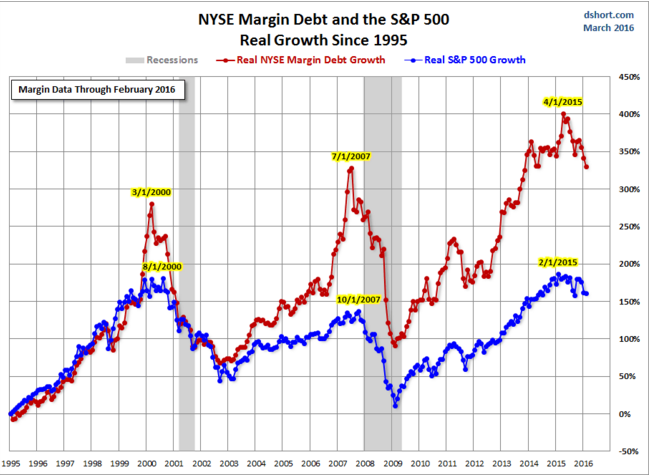
Belåningen har samtidigt börjat falla på den amerikanska börsen, men det har inte skett några gigantiska "fria fall" ännu. Börjar belåningen falla kraftigt månad över månad, så har tvångslikvideringarna börjat och då har förmodligen redan en krasch inletts.


http://www.advisorperspectives.com/dshort/updates/NYSE-Margin-Debt-and-the-SPX

Några av argument för en fortsatt uppgång eller stabil marknad är att centralbankerna gör allt vad de kan för att stabilisera situationen. Exempelvis fortsätter Draghi med sin lekstuga i ECB och FED har sänkt prognosen för antalet räntehöjningar i år. Dessutom går EMU förhållandevis bra efter att Draghi börjat föra ett valutakrig mot omvärlden.

I dagsläget ser det inte ut som att vi kommer uppleva någon ny "finanskris", eftersom det vore exceptionellt om nästa större nedgång blir lika hastig som den under finanskrisen. I dagsläget ser det inte ut som att något är på väg käpprätt åt helvetet, men den globala ekonomin är instabil och frågan är inte om, utan när något kommer gå åt helvetet.

"Any complex system can remain in a critical state for a long time. However large or small, all it needs is a catalyst to start the chain reaction." (Frank K Martin, Martin Capital Management Annual report 2015)

Europas banksystem är fortsatt underkapitaliserat och många stater förblir konkursmässiga. Tillgångsbubblor finns lite varstans i världsekonomin och väldigt få framsteg har gjorts sedan finanskrisens "slut". Situationen i Kina framstår som allt mer ohållbar och hur länge till klarar regimen av att hålla samman ekonomin?

"The Chinese government is trying frantically to support four major markets: its exchange market, its stock market, its bond market (no debt defaults allowed) and of course, the biggest real estate bubble we have ever witnessed. In 2015, China’s foreign exchange reserves dropped for the first time in 20 years – by almost $800 billion from the high. Early in 2016, the trend continues!" (Prem Watsa, Fairfax annual report 2015)

Vid obegränsat med tid se Prem Watsas redogörelse över "unintended consequences" i Fairfax Annual report för 2015 (sida 19 till sida 20)

Framtiden blir spännande oavsett vad som sker, personligen försöker jag förbereda mig mentalt för en framtid där marknaden vänder upp kraftigt. Vänder marknaden uppåt kan det mycket väl bli flera år till av uppgång och frågan blir då var vi hamnar? Jag vågar inte föreställa mig en recession om denna lekstuga fortgår i några år till, och förhoppningsvis slipper jag även föreställa mig en sådan situation. För att bidra till den allmänna optimismen kring framtiden låter jag William White måla upp en bild.

"The world’s financial system has become dangerously unstable and faces an avalanche of bankruptcies that will test social and political stability, according to a leading global banker.
William White, chairman of the OECD’s review committee and former chief economist of the Bank for International Settlements, who suggests the stresses in the financial system are now “worse than it was in 2007”.
Speaking to the UK Telegraph’s Ambrose Evans-Pritchard before the start of the World Economic Forum in Davos, White warned that macroeconomic ammunition to fight further economic downturns is essentially “all used up”.
“Debts have continued to build up over the last eight years and they have reached such levels in every part of the world that they have become a potent cause for mischief,” he told the Telegraph.
“It will become obvious in the next recession that many of these debts will never be serviced or repaid, and this will be uncomfortable for a lot of people who think they own assets that are worth something.”
Instead of pondering whether or not bankruptcies will occur, White suggests the only question that needs to be answered is “whether we are able to look reality in the eye and face what is coming in an orderly fashion, or whether it will be disorderly”.
(...)He believes that easy money policy settings from the Fed, and others such as the European Central Bank and Bank of Japan, simply brought spending forward from the future, creating dangerous cycle that is now losing its potency to spur demand.
“By definition, this means you cannot spend the money tomorrow,” he told the Telegraph." (länk)
Det kan även vara intressant att betrakta hur tidigare björnmarknader uppfört sig för att få en klar bild av hur extremt oförutsägbara björnmarknader är.

Veckans komiska inslag består av ett klipp (satir) om Turkiets president


torsdag 24 mars 2016

Den relativt okända investeraren Frank K Martin

Frank K Martin är ingen direkt välkänd placerare, trots hans fenomenala riskjusterade avkastning. Frank K Martins böcker Speculative Contagion och A Decade of Delusions består av utdrag från Martin Capital Managements kvartalsrapporter och årsredovisningar. A Decade of Delusions är uppföljaren till Speculative Contagion och inkluderar Frank K Martins skrifter mellan 1998-2010.

"Differentiating this book's perspective from others is that it will not reflect on what happened with the clarity and certainty of hindsight, along with the sanctimonious demeanor often in evidence when events are dispassionately viewed in retrospect. Rather the book is intended to capture in vivid detail the emotions that had the upper hand as the speculative contagon spread, often rendering rational thought dumbstruck if not impotent." (Speculative Contagion, preface iii)

Nedan följer rubrikerna från hans bok A Decade of Delusions. Nedanstående rubriker bör ge en viss överblick över Frank K Martins tankar under åren. Jag tror nedanstående rubriksättning var den som Frank K Martin använde i realtid i sina årsredovisningar, men jag kan inte garantera någonting. Underrubrikerna är åtminstone tagna direkt från årsredovisningar och andra skrifter.


(Från preface till A Decade of Delusions)

1999-2000


2003-2004


2006-2007


Inför finanskrisen föreslog Frank K Martin i ett utkast att fonden skulle köpa put optioner mot amerikanska investmentbanker. Fonden köpte aldrig optionerna eftersom det ansåg vara för spekulativt för klienterna. Frank K Martin köpte förstås själv put optioner, och avkastning var absurd.


Motivation för att köpa optionerna följde längre ner i utkastet:

(...)copious amount of leverage made possible by sometimes fleeting liquidity, and the increased complexity in financial innovation (...) The companies about which I am writing are the major investment banks on Wall Street: Goldman Sachs, Bear Stearns, Lehman Brothers and Merrill Lynch, and so forth  (...) It`s hard for me to imagine, however, that the major players  on Wall Street can avoid a body blow to their balance sheets and income statments should the system under which they are operating malfunction in unison. Should that occur i expect their shares to drop dramatically. " (A Decade of Delusion)

Det kan vara viktigt att poängtera att Frank K Martin aldrig skicka ut brevet till klienterna då "the kitchen cabinet" inte delade den extrema oron han kände. Martin förväntade sig att optionerna i ett bästa scenario skulle öka i värde 25 gånger och den slutgiltiga avkastningen blev till och med högre än så. Martin poängterar dock att han först i efterhand förstod hur bankrutt de amerikanska investmentbankerna var och att ovanstående inköp handlade mycket om tur. Frank K Martin har förstås inte rätt i allt, men han har en tendens att få rätt, om än efter en viss tid.

Som jag poängterat tidigare är jag inte särskilt begåvad och jag förstår inte varför någon normalbegåvad individ skulle vilja läsa mina tankar framför en begåvad individs tankar, därav:

Läs Martin Capital Managements senaste årsredovisning. En av fördelarna med Frank K Martins skrifter är att insikterna inte är begränsade till enbart värdeinvestering.

Under den tredje genomläsningen av årsredovisningen började jag göra utdrag. Ganska snart hade jag 33% av rapporten i mitt inlägg och då kan man istället läsa hela rapporten. De mest insiktsfulla tankarna finnes nedan:

https://www.mcmadvisors.com/wp-content/uploads/2015/02/MCM-2015-Annual-Report_.pdf

"One would never have been capable of preparing for the financial crisis bear market without being able to at least vaguely comprehend the impending collision of various disparate elements. Among the many that were quantifiable were the emerging residential real estate bubble, abetted by reckless financial innovation (concurrent with a once-in-a-lifetime debt supercycle), and the continuation of an overly accommodative experimental monetary policy. The combination had the characteristics of a complex system in a critical state

(...) A continuation of the accommodative monetary policy that preceded the last bear market, eight years of ultra-low interest rates, both nominal and real, stabilized the last crisis, but their continued application seems to have destabilized everything else since. Interest rates are used to price risk. In the current environment, the risk-pricing mechanism is broken. The S&P valuation levels foretell longer term future returns that are likely to be de minimis. The link between the market and the quantifiable elements of the economy and the financial system is not often this tenuous.

(...)The amalgamation of investors that we call markets have their seasons of recklessness—whether because of excitement over the latest innovation or, as of late, years of cumulative, yield-starved desperation—when they carelessly disregard risk in pursuit of return. When millions of investors obsess over some mass delusion, reinforcing each other’s convictions contagiously, amplified by feedback loops, market prices become disassociated from underlying values.

(...)Quite unlike the 1930s, the “technology innovation” bubble’s 50% decline in the S&P from March 2000 through July 2002 had only a muted impact on investor sentiment. The damage was not universal, being confined largely to the information technology sector representing 30% of the S&P’s value at the peak (and 13% at the bottom). The accompanying “growth recession” was comparatively mild as the Fed again intervened, driving short-term rates down from 6.5% in October 2000 to 1% by November 2003. Because the damage was not ubiquitous, most investors quickly shed any remnants of the fleeting glass-is-half-empty fears and embraced the “financial innovation” bull market in housing and stocks. The “easy money fool’s rally” ensued, ending four years later in 2007. There was no dead low-tide moment.

The six months of purgatory from September 2008 to March 2009 again did not crush the momentum of the speculative contagion that had been building over time. Within a year of the bear-market low in March 2009 and the recession’s end three months later, risk taking ramped up at an unexpected clip during what may be remembered as the now seven-year-long, wide-open-spigot, “monetary intervention” bull market. Once again, the inevitable was postponed.

Entering 2016: A Bizarre World Addicted to Easy Money
The reigning delusion has been the elixir of artificially low interest rates. Ever since the Crash of 1987, the Fed has injected speculators with an “upper” every time a market swoon threatened to spill over into the real economy, with each hit needing to be stronger than the last. Finally, paranoid over the possibility of a repeat of the 1930s, the Fed progressed from syringe to IV drip in 2008, drugging short-term interest rates to zero and strong-arming longer-term rates lower through multiple quantitative easing (QE) programs. Going from high to high, investors have never been subjected to the withdrawal pains, which are the human cost of detoxification. December’s baby step toward raising short-term rates, and the equivocation about the course of rates ahead, makes Dr. Yellen the monetary physician who is administering methadone at the inconsequential rate of 10 mg per day. If we are ever to have a sound basis for rational expectations and stability to return to the capital markets, the drug of artificially low-cost credit must be withheld and the addicts must hit rock bottom, “recover[ing] their senses slowly, one by one.” If weaning a large cadre of financial junkies is not the Fed’s greatest nightmare, it should be.

(...)Natural disasters like the record-setting Mississippi River flood now under way (as of this writing), the Fukushima tsunami in 2011, and the Haiti earthquake in 2010 that killed over 100,000 are deemed so unlikely that they are called 100-year events. Each had a presumed 1% probability of occurring within any given year. Importantly, if any one of these tragedies had not occurred in 99 years, the probability in the 100th year would still be 1%.

Man-made destruction, however, is a different animal. The Great Depression nearly a century ago decimated America’s financial and economic income and wealth. The devastation lingered for 10 years. It might be reasonable to call a business calamity of that magnitude a 100-year event. Unlike most events in nature, however, depressions are no more random than the volcano that inches year by year toward the earth’s crust and finally erupts. The probability of both bursting on the scene increases over time

... When the U.S. plunged into financial crisis in 2008, it was like so many stacked dominoes toppling. The essential point here is that the dominoes had gradually and unceremoniously grown in number over time. The progressively more complex financial system had reached a critical state, like a dangerous accumulation of snow on a mountainside, or a forest that over the years had accumulated an ever-thicker floor of dry tinder. Any complex system can remain in a critical state for a long time. However large or small, all it needs is a catalyst to start the chain reaction.

(...) This truth of human nature cannot be overstated: There are no new eras, only new errors.

(...)Hans Christian Andersen’s well-known fable is about a mass social delusion. The emperor’s vanity made him susceptible to the entreaties of impostors who sell him an imaginary suit of clothes that will be invisible to all but those who are “in the know.” Since neither his minions nor, eventually, his subjects wanted to admit that they were not privy to the special or secret information that he possessed, the charade cascaded into public spectacle. Centuries later social psychologists have given the phenomenon an educated name: pluralistic ignorance. Put simply, it is where no one believes, but everyone believes that everyone else believes. 

A classic example is in a classroom setting where, after having presented the students with difficult material, the teacher asks them whether they have any questions. Even though most students do not understand the material, they may remain silent. The students interpret the lack of questions as a sign that the other students understood the material and, to avoid being publicly exposed as the stupid one, are reticent to ask questions themselves. Each student is aware of his or her ignorance with respect to some facts—but believes that other students are not ignorant of those same facts. Pluralistic ignorance understandably can lead to errors on a grand scale. It’s a social phenomenon for people to make systematic errors in judging other people’s private attitudes. Nowhere is this more apparent today than in the public’s perception of the U.S. Federal Reserve System, a secretive and largely unaccountable monopoly, with an unprecedented experimental monetary policy of driving the price of credit to zero for the last eight years and counting. Even though we ordinary folk grasp the illusion of the proverbial “free lunch,” the Fed’s material is infinitely more imposing than that presented by the aforementioned teacher. We assume that others are privy to the special powers that the Fed possesses, and thus we suspend our disbelief. No one believes, but everyone believes that everyone else believes. 

This herding process is abetted by the imperial power of the Fed over an individual’s free thinking and reasoning. As we have already seen, most people are ready to believe expert opinion even when those opinions contradict their matter-of-fact judgment. To be sure, confidence in the power of the Fed is not without basis or precedent. The prevailing prescription of applying the monetary palliative to truncate episodic maladies big or small began with Alan Greenspan in 1987 and continues (unexposed) to this day.

(...)Andersen’s emperor (for better or worse, he was in power for life or until deposed) had no choice but to march in stately procession before his subjects, parading in his underwear, his vanity exposed but with no place to hide. By contrast, today’s monetary royalty has felt no obligation to hang around in office for eventual humiliation. Greenspan passed the baton to Bernanke just as the subprime crisis was erupting, and less than two years before the Great Recession. Bernanke, in revolving-door fashion, dished the hot potato crown to ambitious Janet Yellen in early 2014, just as the great unwinding of the process of monetary extremism was set to begin, its unintended effects still ahead." (Martin Capital Managements Annual report 2015, länk)